Showing posts with label economics. Show all posts

Friday, June 17, 2011

Too much, Too Fast, Too Soon? Commentary on China's Economy


Commentary

Too much, Too Fast, Too Soon?

There is a massive gap between the super wealthy and the poor. Shanghai is very much a 2 speed economy . You have your Maserati, Porche, BMW dealers all lined up in brand spanking new office buildings. And then you turn the corner and there is a guy on a rusty bike hauling bales of hay and bamboo down the street wearing peasant clothes. In a June 13, WSJ article, "In China, Women begin Splurging" apparently 30% of the 400 Maserati's sold last year were to women who were self made billionaires!

I don't believe anything this government says to the world including what it tells its own people. What harmonious society? In a recent copy of the China Daily and the WSJ.com there have been bombings and riots in about 5 different locations around the entire country in the past month. The subways all have metal detectors in them.

Now while it sounds horribly pessimistic, there is a lot of "sweeping the dust under the rug" but the problem is that its not simply "dust"  - they sweeping massive amounts of social problems along with it. And eventually its going to heat up and blow up.

In general try to avoid shanghai in June - august. It is extremely hot and humid. It is also rainy season.

Comment from my friend Alex - " In China, its almost like complete obliteration of self in this city. In the serbia/ eastern europe - they hate each other but they're not out to erase all of their history their past their culture, like this complete razing to the ground of the old buildings in many parts of shanghai."


Thursday, June 16, 2011

Hackerspaces in Shanghai

Saturday -

we go to the hacker space - xianchijian - it is pretty central  - one stop down from the Jia'an temple on Jiansu Road.

They are trying to do the hackerspace noisebridge thing. It is located on Anhua road in an old factory where a lot of the local people are and its really nice to bump into a lot of shanghainese speakers. Many people in the space are american, canadian expats.

====

Sunday

Xianchijian - went back to see their bamboo hydroponics workshop but it was cancelled. Heard Ricky really like Tianzifang, so I went to check it out.

On Jiangsu lu? there is a french owned store - china-africa fashion. About 1/2 a block down is one of the alleyway entrances to TianziFang. Old architecture has been preserved in this alleyway city. super easy to miss the sector if you didn't look down an alley

Tianzifang - is down an alleyway. I almost missed it the first time around. Even within the maze of old houses, its easy to miss the good spots. A must see place. The inside architecture in some buildings are gems. It was nice to find a place that maintained some of the old french concession character.

Wednesday, June 15, 2011

China's Demographic Time Bomb


One of the issues that Joe discussed (US visiting professor of economics at Fudan, also sits on real estate investment boards) is what is going to happen with China's own IP when it starts having it? Because right now they are ripping off other people's patents and copyrights and copying books and tv shows and movies like they don't are about the licensing restrictions. In 5-10 years what is going to happen when they create their own IP? How are they going to protect it, if they don't respect other people's IP?

There is also a demographic time bomb waiting to happen, as the largest part of the working population severely declines starting in 2015, because of the one child policy, labor will soon be scare and expensive. Even if they dropped the one child policy today, there would be a gap between '15 and 2026 when the children come of age to work, at the age of 15. So a big part of the massive push for outside investment and manufacturing in china was because they had so many people who were in the working age range from 1990 until now that were born during the great leap forward.  

So we are likely to see a big slowdown after 2015 in the China's growth because there are fewer workers. It may also be the only chance it gets to transition to a service economy from a manufacturing economy, but it depends on the transition to the new party in 2012; we don't know if this new leadership is going to make a mess of things or if they are going to be able to handle the delicate transition. Especially with the amount of civil unrest going on and shifting the consumption away from real estate and toward a consumer market like the US.

Sunday, June 12, 2011

Internet and Tech in Shanghai


getting out of shanghai metro and Internet censorship

=======================================


There are frequent rail lines to suzhou, similar accent to hangzhou, i'm told that i have.
hotel suggests to buy the train ticket to suzhou the day before departure as they get sold out fairly quickly.
Internet filtering makes it really difficult to access any sites outside of China. The service it intermittent. Gmail is really slow. This city is probably the most frustratingly difficult city to navigate in my recent experience. I think the reasons are a combined problem of a

1) really confusing map that combines both english and chinese characters.
2) metro system is not well laid out - there are now 13 metro lines and some of the lines seem haphazard and redundant.
3) the metro line is slower than taking a taxi during non-rush hours.
4) The size of the city is very large. The distance between metro rail stops fairly large.
5) There are many metro stops per line.  
6) Places with similar sounding names.

Subway - line 2 is old - the cars . line 10 is very new opened as recently as 2010 for the shanghai world expo.

Very much a 2 speed economy.  i thought they would have moved past this problem already but i am guessing that 10 years is too much to expect too soon.

Ricky said that - power brownouts  are expected this summer. especially with the number of air conditioning units coming online they need to restrict power usage.

In a way it feels like the government upgraded the infrastructure, the roads, the malls, the housing but they forgot to upgrade the people. English fluency is a rare commodity.  Students who have studied english speak it really poorly including those who work in tourist destinations, hotels, airports. I don't expect the average person to speak english well on the street, but after the 2008 olympics and the 2010 Shanghai Expo, I would have expected a little better.  If I had to rename the country, it would be Infrastructure's Republic of China, not people's republic. :)


Tech Sector

We visited a mobile video company called Wondertek referred by Joe. They are looking to acquire new software technologies. We talked to their founder CEO. The problem with China Mobile phone service is that its is government controlled. You have to have a person filter words that are used in your application. Wondertek has managed to squeeze its competitor out of a large part of the market. The competitor was a french company located one floor down from their office and was recently acquired by an Israeli company. The competitor has shrunk its size and was mostly europeans who were working in the offices. The Wondertek guy says that europeans are lazier, but I have a hunch that the chinese guy 's close relationship with China Mobile is mostly because he has some relationship with party members that are controlling China Mobile. Like everything in China, you have to be in bed with the party in order to get large amounts of business. Square footage of office space is pretty high. more than $1/sq ft. This is on the pudong side, near the river.


Wednesday, June 8, 2011

Shanghai for a week

Notes: 6/7-8/2011   - Shanghai

Shanghai is a really big metropolis. Does not have the claustrophobic crampiness of HK. However, it is so spread out, but the weather patterns make it difficult to tell how big it is from even high rises.  The haze - is it pollution or is it just dense haze all the time?

There are 13 subway rail lines , first line apparently built staring 1995 ? Need to double check the date on this . Subway rail line #2 is visibly older than line 10. were probably built in order of line number is my best guess.  The Line 10 subway cars approximate the new HK MTR rails in their electronic sophistication. The line 2 cars have a very loud and annoying buzzer for their door closing. The Shanghai subway system is one of the more difficult systems to navigate on arrival, mostly because there so many lines. The good part is that there is english/chinese on every rail station.

subway lines in the city close down at 11pm . The subway lights are also fairly dim. I'm not sure what the reasoning is behind the low wattage  lights. This is present in both new and old stations. Also i see a lot of fluorescent tubing

Bar manager at The Long bar, waldorf astoria restored from 1930s glamour is shanghainese, says that there is a lot of price inflation but not necessarily wage inflation. Says that he can make 10k rmb as a manager here in shanghai but in tokyo can make 10k as a regular bar tender, back in 2008. Prices are exceptionally high, for a diet coke beautifully presented cost 55RMB, which was about 9 USD! Current exchange rate is 6.47 RMB = 1 USD. The experience was worth it though. (pic here IMG_1257.jpg).

The Lights at the People's square are shut off 11pm??? I asked the cab driver if this was a just a weekday event or if this is was a regular case. He replied that it was a regular event, even on the weekends? that the lights were shut off. The photos show how dramatic the difference is. IMG_1290.jpg is about 10 min after the lights are shut off. IMG_1222, IMG_1278 , IMG_1283 is a little before 11pm.

see pictures here: http://www.dropbox.com/gallery/14421298/1/shanghaiPhotos?h=276e7e

There is a very clear disparity between areas like the bund and the people's square and the spaces in between. Most interesting to note: If you go back 1 or 2 streets from the bund on a normal, not highway street, there is little traffic, mostly dominated by cyclists and motorbikes/mopeds.  There are many very grand neocolonial (style?)  historical buildings that are simply vacant or boarded up. Its as if they only opened up the front row of the bund to the public and "showcased it" in a hurry. for events like the 2008 olympics or 2010 expo?  Some of the buildings have windows boarded up with new international fashion brand names eager to occupy the new retail space. sometimes a view into the building is visible and you see old cabinets, perhaps rooms untouched since the 1940s?

The old and new simultaneously exists. Its almost like having an angst teenager? Sophisticated yet still immature in so many ways. Almost schizo in personality. How do the people manage here?

The significant gap of wealth is really obvious and extreme. Its as if the china of yesterday simultaneously coexists side by side with the new: the old with bicycles and tuk tuk style motorbike cabs mixed in with new wealth and high end brand names, the audis, bmws, japanese brand taxis, the pradas, guccis and so on.

Most of the purchasing activity seems centered around mid-level retail brands. I noticed a lot of activity in stores like the gap or mango, but hardly anyone walked into luxury boutiques, such as Dior, E. Zegna.  That's a lot of high end retail .

There is a McDonalds in People's square that is open 24hrs. The lights are strong and bright, assumingly all the lights in the square that are on after 11pm are paid by the tenants? and all the other lights are sponsored by the government? When the lights go off at 11pm, there is a large crew of cleaners that mop the tiled floors with soap and water.

It will be interesting to see if the bund's lights also go off at 11pm . I would be very curious to know. More on the bund : http://en.wikipedia.org/wiki/The_Bund My grandfather and great grandfathers worked here at the old HSBC bank in the 1920-30s. Influenced by the west, my maternal grandmother is catholic. Both maternal and paternal grandparents left with their children ( my parents ) pre- 1949 revolution and ended up in Hong Kong because it was British Territory at the time and protected from the communists. Hong Kong is an extremely capitalistic market today, even though it is SAR, because of the 50 year hand over deal with the UK. More details on HK’s history: http://en.wikipedia.org/wiki/Hong_Kong

The big difference between Hong Kong and the mainland is that most people don’t speak english even though there are signs that are bilingual. Hong Kong has the advantage of blending both east and west cultures. The majority of people who live in Shanghai today are not orignally from Shanghai. A lot of people have migrated from the city and only 40% speak the local dialect - Shanghainese. Nationwide, everyone is mandated to speak Putonghua , also known as Mandarin. I only understand and speak shanghainese, and although some of the words in Putonghua are similar, there are plenty of people who don’t understand Shanghainese. There is also a lot of confusion as to why I don’t understand Putonghua, but this is an extreme anomaly in China.

I’m also asked by local people - “ why would my family even want to leave China, because isn’t Shanghai the best city in the world?? “ (which in my opinion is not true based solely on the amount of pollution.)  Apparently a lot of the pre 1949 history was wiped out in the educational system, and people don’t really know the details before the red revolution. Hong Kong, is entirely different - its very westernized and people have a lot more freedom. The internet now is so choked off in China, its almost like we can’t breathe, and we have a difficult time accessing a lot of wikipedia web pages . Gmail is intermittent and so is google.

The bund, even with its historic buildings only, feels almost larger than life grand. Its interesting that the modern skyline counterpart is built directly opposite the bund. The river separates the old bund architecture from the space age modern pudong side.

Pudong is mostly comprised of financial buildings and the infamous space needle. The skyscrapers rival HKs and have no worry about running out of space.

A lot of the high end architecture in pudong , people's square, and Luwan has a "larger than life" , extremely dramatic feel to it.
The problem with the weather is that it is difficult to see of the skyline from a distance. So much of the cloudy haze blocks views from afar.  

We went up to the a round space bar in one of the hotels near the people's garden, hoping to get a better view of the city and pudong from 46 floors up, however, it was impossible to see much with the haze in the way, even at night. The lights do not penetrate


Monday, January 12, 2009

Rounding out East Africa: Rwanda, Uganda

Kampala 057
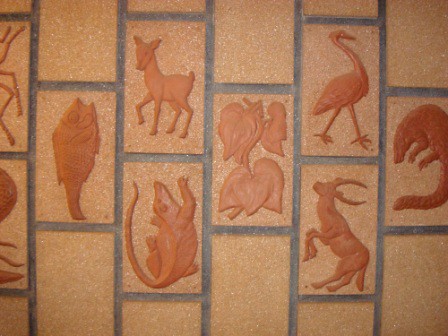
Animals symbolizing districts of Uganda
Its been a while since I wrote. Funny how when you stop writing, you also stop hearing from people. Bummer. Does that mean when I fall off the face of the planet, nobody will remember me? Even on my birthday in 2 weeks? Scary depressive thought.

Throughout this entire trip, I've been debating if the some of the crazy throughts are the effects of depression and dementia caused by malaria prophylaxis. Everyone says that Malarone shouldn't have any side effects but for an extremely drug sensitive person like me, anything will have an effect. Some of you even know that after 1 benadryl I can't even drive a car straight. I hate how drugs f*** with my body. Over the past two months, I notice that I get weird dreams and mild stomach cramps, depending on what time of day I take Malarone. It also seems to have more of an effect during different hormone cycles. I'm just really glad I'm not on Mefloquine, because people who are on that have experienced much more severe effects - hallucinatory, depression etc. The way I've been coping is to keep myself extremely busy, but since I've been traveling alone, and taking a break its been a little difficult.

I've mentally checked out since I left Moshi. A lot of the stress of traveling with another person and living with other people are gone, but I can't say if it's any better by yourself, especially because I've suddently become a bigger target for hassle.


Backlog to Kampala, Kigali -- I'll try and make this as short as possible.
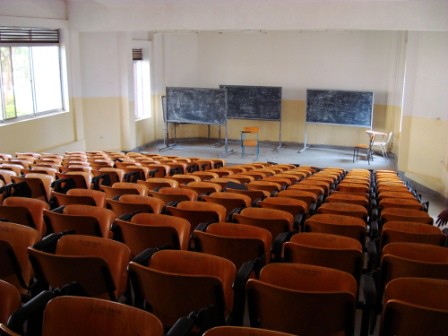
KIST, Kigali, Rwanda
Chalkboards covered in partial differential equations at KIST

Kigali, Rwanda - Dec 27, 2008

The plane ride from Kilimanjaro to Kigali was ok, except the landing was a bit rough. Propeller planes and cross winds don’t do too well together. When we get to Kigali, everything is shut when we try to visit, even the genocide memorial. You know what is funny is that I am not here just to visit the memorial. I’m not a fan of miserable sites. I don’t like to come in with high expectations either, because that just creates disappointment. We are wandering the town and the university teaching hospital is there. We try to get a tour but can’t. There isn’t anything there until Monday, and I’m trying rudimentary French to get us by.

The fact of the matter though is that most people speak English. The only place where we heard French spoken widely was at the hospital. Everyone on the street, the stores, etc were speaking English. We are told the streets that we walk on are were the horrors happened. People’s bodies were strewn all over and dogs started eating them. They had to shoot all the dogs later because they had developed a taste for human flesh. Because the memorial was closed we went to Hotel des Milles Collins, where many refugees were hidden in the pool. Part of this hotel is being renovated, including the pool area. It has a 1960s architecture. Nothing mentioning the genocide. But everyone here is affected by it in someway. Even our bartender at the hotel who is the only surviving member of his family. I find the stories from the locals fascinating and telling of what happened here.

Kigali
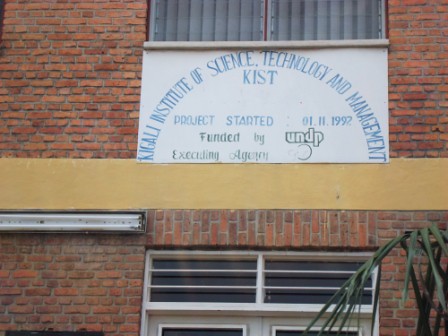
KIST's Original Old Building.


We stumble across KIST. I remember seeing this briefly in some lonely planet guide and we walk on in. The place is open, thankfully. KIST is the Kigali Institute of Science and Technology. I was curious to know where the current standards were. The first few buildings we saw were old and decrepit. There is sign above one that says the institute was funded by UNDP and was started in 1997. We wander around and pass by a cafeteria. Some of the students are still hanging out watching football in the cafeteria. A student follows us out and we say that we are just visiting, looking at the grounds. He is a 5th year civil engineering student here. As we walk further into the grounds the buildings change rapidly. There are giant, new buildings, that rival some of the largest research buildings I’ve seen at Stanford university, and in silicon valley. The newest building has not opened and was built by a Chinese construction company. The building was financed by the UNDP and the land was donated by the government. The land was previously military compounds and you can still see remants of buildings around the campus. Within the next few years, a new stadium will be built and another tract of land has been allocated for building dorms for students.

The new research buildling will be dedicated for research in the pure sciences: bio, chem, physics. Most of the labs here are closed; we only have a peek through the cracks of the doors. But what is most telling is what is being taught here. There are both science and engineering departments at KIST. The blackboards are covered with the last set of review material before exams a few weeks ago. Just looking at the math told me a lot. This is definitely NOT a toy technical school. They mean serious business. I see applications in multivariable calculus, partial differential equations, summations and statistics at a level I did not even study. They had a food science technology program, electrical engineering, civil engineering and more. Our student guide, Francis tells us that many of the professors are expats, from Russian, Bulgaria, America, India. They are given research opportunities in addition to teaching and many visiting professors also come to exchange ideas. KIST is Approaching World class. And I was impressed. Not even 10 years after the start, they are well on their way to moving Rwanda forward with this institution. They have multiple campuses spread out throughout Rwanda. This campus sits above the prime minister’s house and supports 2000 government sponsored students and about 3000 private students and night school students. To me, this paints a positive outlook for the country.

We go to this place called Heaven restaurant on the last night. The view is beautiful. From reading a bit about the restaurant it sounds like an american funded it and trains locals to deliver a restuarant/bar to NYC standards. While we're eating a chinese guy approaches me and starts chatting it up with me in Shanghainese! It is a little spoken dialect of chinese and I can't read or write it. About 7 million people only speak it worldwide, and its mostly concentrated near the city of Shanghai, China. He isn't the first one I met on the street that day; 3 others cornered me at a store to ask me where I'm from and other sorts of questions. They don't get to see many of their native people here in Rwanda. But most of them are from Chinese road, infrastructure and construction companies that are under contract to build for Rwanda. (I'm assuming something like the UNDP financed buildings at KIST).

Kampla, Uganda - through Dec 31, 2008
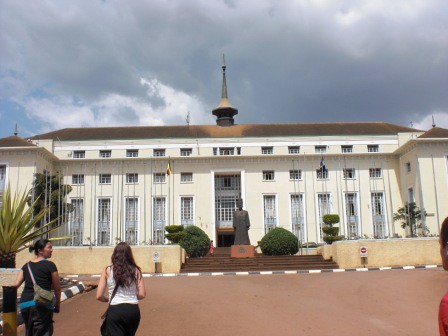
The Parliament, Kampala Uganda
The Ugandan Parliament

We get tickets for the bus to Kampala. It costs 8000 Ugsh for an 8 hr ride. That's about 16 USD. It leaves at 5:45 am, so we really have to scramble to get there on time. There is no announcement when the bus leaves. It just jerks and takes off whenever it feels like it. I have trouble remembering where my ticket is, and they come by and check it several times. Its really hard to dig for things in your bag with a cup of coffee and while the bus is swerving 180 degrees to 180 degrees every 20 seconds. Harrowing. Along the way we see a few accidents. The driving is madness. They bypass cars on curved roads.

When we first get on the bus, we run into a guy who is a money changer. He was in the back wearing a suit and so I thought he was the Kampala coach bus employee. So wrong was I. I hold out tanzanian shillingsand ask him to change it. I ask him for the rate, and then hand over some 200,000 TZSh and 10,000 RwFr. I get back about 190,000 Ugsh. Which is not good, but at 5:45 am, groggy, I know that it can't be that far off. She then hands him about 60,000 TZSh and says nothing, he hands her 32,000 Ush. Only 2 hrs later after a bone jarring swerving ride through the Rwandan mountains when we get out at the border I realize something is NOT right.

2 hrs later, we get out and form a line for the Rwandan exit border. You have to walk across the border to Uganda, and the bus waits for you on the other side. During the walk across I am hounded by Money Changers. I hear them yell out the exchange rate. I mention TZSh and one guy says I give you UgSH 1 to 1 for TZSh. SHIT. I start freaking out. I didn't think of it this morning but now it registers that Ugandan is 1700, and Tanzanian is 1300 to 1 USD. That means I got SCREWED. How much I don't know and I am groggy as all hell. The guys hound me. One has a calculator. I trying to do math in my head and think about if i did get screwed or not. I look in my pocket and there is only about 28000 USH. Did the guy actually give me only 10% of what I am supposed ot have?? Panic starts to set in. We are yelled at by the Bus staff to move it and get our visa at the Ugandan border. They are yelling at us. I am yelling back still stupidly thinking that the money changer was one of the staff. I'm realizing now that it wasn't. The bus staff are angry we aren't moving. I get in line. Michelle is begging for money from me because she doesn't have enough cash for her visa. I can't think straight. The bus driver is yelling at me at the VISA booth and telling me to go. He looks like he is going to punch me. I forget my passport, but Michelle is right behind me. Thankfully the customs agent gives it to her and we get back in the bus.
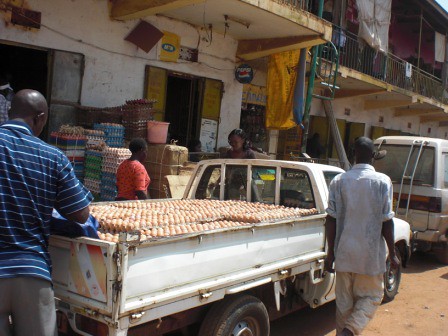
Kampala markets
Outside one of Kampala's Markets
Back in the bus, I count all of the money I have and I realize I am probably only short about 20 USD equivalent. But the exchange was not as bad as 50% exchange rate that Michelle got. As we cross the border, we get internet access on the iphones. There is no Edge internet in Rwanda. The landscape also changes dramatically. Rwanda has dozens of densely packed hills close together with very small valleys. Uganda is better farm land and you can see it change quickly. The hills are further apart and the valleys are ripe with irrigation and agriculture. The land is truly rich. It goes from hilly and spaced valleys to plains and rain forest all within a space of 6 hrs driving to Kampala.


 As we get closer to Kampala, more people board the bus. Michelle and I get split up and two natives sit between us. One of them is a parasitologist from Kampala. He gives me an informative tour of the country as we pass it. There is a lot of really rich land here but a lot of people don’t really want to do more than what they have to, according to him. It is sad, but he says it is part of the culture. And culture is hard to change in the people. We pass through several national parks on the drive. I have my own personal tour guide! He tells me about the problems with the Congo. The land there is exceptionally wealthy and he thinks that it will never be developed because everyone is always fighting over it. Kampala is full of slums on the edge. This is the dirtiest city I have seen yet here in East Africa. It is ridiculous. How much garbage and sewage there is here.
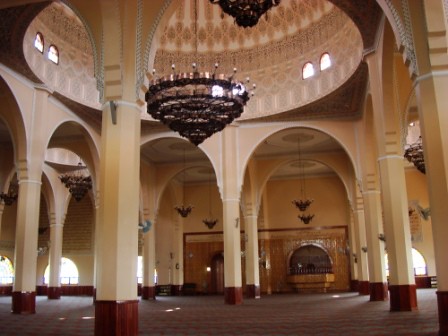

Kampala 054
Mosque in Kampala, Uganda


We see bulls with giant horns that local to Uganda. And then lots of Mzungu cows. It similar in many ways to Tanzania, but also different in small ways. The land is really green lush and rich for the most part. Along the road, we even pass the equator; there is a giant ring to mark the spot. Along the way we see an overturned truck full of wood. The bus ride is not an easy one. Several times I felt like it was going to tip on its side. Lots of by passing but the driver also doesn’t seem to have much concern for the bumps. The speed that he went over several of the bumps sometimes threw us up out of our seats in the bus.

CIMG2280
Market in Kampala
Driving is crazy here in Uganda. It makes Tanzanian driving look nice. There are also motorbike taxis here like those in Rwanda. I brave my guts and actually get on the back of one these. They're called boda bodas. It costs about 2000 Ugsh to get to town from the 5-7 km where we are. Actually I'm terrified so I make a deal with the driver to pay him more if he drives safely. Some of the worst accidents happen on these bikes; there are women who ride them in skirts - sitting SIDEWAYS - on the bikes - extremely dangerous. The daladalas here all have a blue T marked on them. Unlike the ones in Tanzania, there is no sign for the destination, so its up to the money collector/caller to yell out the destination continuously; a very tiring job.

At the hostel, we meet a couple of German boys who are down from Yei, Sudan for the holidays. They just arrived and are looking to bargain a price for a city tour. The three of them are working for a German missionary in Sudan. Two of them are building houses and the third is working in accounting in the offices. Yes you heard that right they are on the Southern part of Sudan. We split a city tour of Kampala with them and visit the mosque, the parliament, a few markets and lake victoria - the source of the nile. The mosque we visit is huge.
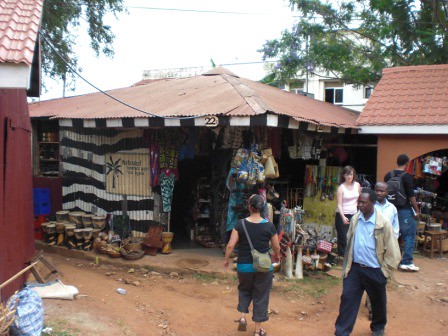
Kampala, Uganda
Shopping in Kampala
What's interesting is this - Yei is on the southern border of sudan and is tightly protected by UN helicopters and other armed vehicles. The area of conflict is isolated to a part more east, but not very far away at all. In fact in the daily papers, there is a map of the conflict area and you can see that Yei is also on the map within a few hundred kilos or perhaps less. They have been living in Yei for more than 8 months and will stay for almost another year. From the pictures I've seen, a lot of the village looks like every other village in east africa. The same kind of mud huts, markets, the same kind of dress. More of the houses are grass thatch instead of corrugated metal. Even a sign says "Karibu" so we know that Swahili can extend that far north. As dangerous as the media makes of Sudan, it's not the whole country. And parts of it where these fellows work are tightly protected. The Southern part of Sudan is also experiencing a good amount of grown lately, people from Kenya and Uganda have been migrating over is masses to open more commerce there in the region.

Don't believe everything you read. hehe
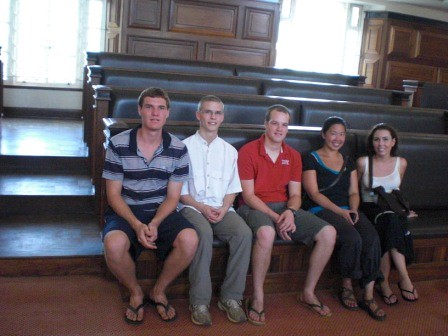
Kampala, Uganda
Sitting inside the Ugandan Parliament

After a few days, Michelle is not feeling well and wants to fly to Kilimanjaro, so We don't make it to Nairobi. Durn. I would have like to see big bad Nairobi but maybe next time. We make a bee line for Moshi. On the flight, we are joined by the national Tanzanzian soccer team. Their head coach and assistant coach is importo from Brazil. Pretty cool. I have a neat chat with the old man and learn a few things. Their team is young. They are scrimmaging with other east african countries and recently with Sudan. One of the young fellows taps me so that he can borrow the newspaper I'm reading. This is typical of Tanzanians. Papers are for sharing, even with Mzungus. If you're holding it and not reading it, you'll get poked to share it. Same thing happened on the ferry to Zanzibar.

Thursday, December 25, 2008

Last week in Moshi, Arusha, Safari, and Kigali

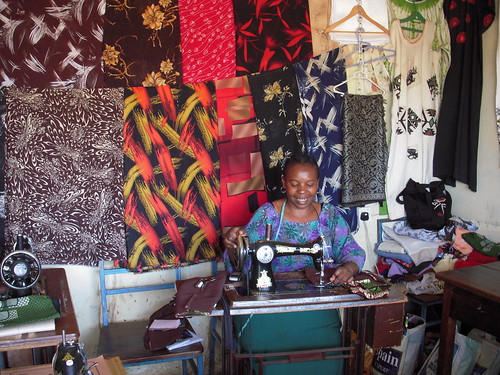
WeeceTailoring01
Dec 19 was my last day in Moshi. This final week was really different from the first 3 weeks. At WEECE, Mama mrema came back in town and basically asked me to drop the schedule. I have yet to post case studies from Week 2 and 3, but I promise I will.

I help her write more letters and work in the office at the beginning of my final week. Her major project right now is getting a clinic in Nganjoni village built. Writing and editing for her is a challenge but I'm glad we're making progress. The Canadian Embassy has promised the project a grant but they need the approval of the district commisioner of Moshi. So we visit him at his office, along with TSF (terre sans frontiers), another NGO that is doing the project in conjuction with WEECE. He gives us his blessings, and then we move on to the Executive District Commissioner of Moshi, and Moshi Rural for a formal letter. When we walk into the office there, surprise! The Executive District Commisioner is a woman! The District comissioner says to me, you see, Gender Equity. We have, here in Moshi, heh heh. She is my boss. I get asked how long I've been here, how much swahili I know. I mumble a few words. Mama Mrema asks me when the hell am I going to really learn swahili? I say "Kesho" and she bursts out laughing. (Kesho means tomorrow, oh yeah, of course I'm terrible at learning new languages.)

On Wednesday, I'm join Mama Mrema for office work in the morning, then a visit to the Regional Commissioner of Kilimanjaro's office. This guy is a big honcho; he's almost like a governor and reports to the Prime Minister. The number of UN cars in the compound certainly shows. Our caravan moves to the Mkombozi vocational school where he is given a tour, to see what progress they have made. He is also invited to address graduation. I get a lucky chance to talk to him. When I say USA - He mentions that he has two children and he sent them to Tennessee to go to college. There is more than just a graduation ceremony; Mama Mrema is on the school board and gets to sit on the stage. Its a really long ceremony that goes on for 5 hrs!! It is scorching hot outside. I am about to die. Things are disorganized but organized. In the middle of the ceremony; people just wander about, speeches are going on simultaneously, followed by dance performances, the grads just wander around getting on their gowns. Little kids float. A truck backs its way into the ceremony between the stage and the grads and unloads furniture. Some guy rides his motorcycle partly into the ceremony then realizes halfway that something is actually going on? Um, that wouldn't happen in the US, would it?

My final two days I spent with Janine where we visit her placement with TAFCOM. I've been curious to know what is going on with this organization. What they do with the volunteers is bring them to homes with HIV/AIDS patients. They have projects where they try to provide assistance to low income families with HIV/AIDS. Of the two days, we visit about 3 homes each in the Pasua area of Moshi. This area is poor, rent for a 1 room house is about 5000-8000 TSH per month. Divide that by 1330 to get USD. Many people have no income or depend on their working children for income. Others are employed part of the year as coffee workers. Their immune systems are compromised so many cannot perform hard labor and nutrition is at a minimum. Many also do not have education beyond primary school. It's not clear to me how this organization is trying to accomplish assistance. They claim to have a plan to teach people skills so that they can sustain their daily needs and nutrition needs as HIV patients, but we weren't able to find or see a concrete proposal or budget for this. One of their plans is to teach local people mushroom growing as a source of income and nutrition. Mushroom growing is successful in Arusha and Mbeya, but if you look at the climate, both of these areas are lush, damp and green. To grow mushrooms successfully you need damp, humid dark soil consistently, unless you have the means to control for the environment artificially. This is a far stretch from Pasua. Pasua is extremely dry, hot, and while sometimes humid, the earth does not lie. It is barren. One hour north, toward Mt. Kili you have lush green, humid, tropical, and coffee trees grow there. But put a plot of land in Pasua and expect to get a mushroom project working within reasonable cost - I really question that. Large scale mushroom cultivation, as I know of it from the view of commercial purchaser is not simple, or straightforward in the USA. It takes skill. Small scale is different but if this is for income generation, it sounds like its going to generate terrible margins. Also we hear that many of the volunteers come here and give food and money to the families but it seems to defeat the purpose of the organization's goals because they want volunteers to adopt and sponsor families. We're not sure how this is really sustainable. It is also very difficult, to get straight answers out of the patients and the NGO workers. They do translate, but it can be hard for them to get answers because some issues are taboo and the means of asking is very roundabout - for example, I can't ask - what's the most pressing issue for her family right now?

I hate to sound like a cynic but this is my opinion and I only saw the people and organization briefly, so the skepticism may be unfounded.

I wish I could stay for another week. But sadly I have to leave because I am going on safari on Saturday. I leave Moshi friday afternoon and take a cab to Arusha. With the amount of luggage, I was told it would be safer to do this instead of dalla dalla. The house manager, Baba Fulgence asks me for a lift. No worries, I say.

On the way to Arusha, we can see many many houses that are half finished. I ask why. Unlike my asumptions, it's not because the people are too poor to finish them. There is a land grab - as the population grows, people want to buy land for their children so they have a place to settle. However, the government will take the land back if there is no house on the land. So people compensate by buildling half a house, and leaving it there until their children are ready to take it.

Unlike Moshi, Arusha is lush and green. You see more Mzungu cows. (cows that are like USA cows without the humps on their back). Baba says that the Mzungu cows are stupid and need hormones and lots of grass to prop them up or else they can't survive in this climate. They also need to be tied to the trees by the road because they are so stupid they don't know how to get out of the way when the cars come charging at them. The native cows here are skinny and have humps to store fat - fuel for a drought. They can also walk long distances without food; bottom line, they're adaptable to the harsh climate.

I meet Michelle in Arusha for our safari. She will be volunteering with CCS in January and we are traveling the next two weeks before her placement starts.

We do the tourist thing 4 days in Ngorongoro, Lake Manyara and the Serengeti. The animals were great. We even saw a cheetah eating lunch. I think what shocked me most was the ecology and how fast it changed from region to region. Hot, cold, dry, damp, moist all within a space of an hours drive. Oh, and we were visited by water buffalo outside our tents in the middle of the night chomping away at the grass. So Loud. Gosh the chewing was louder than their hoofs.

I don't like to plan things to the minute; especially here in a place where nothing is guaranteed to run on time. So the basic plan is to visit Rwanda, Uganda and back to Moshi in a circle. Originally I was going to take a peek at Nairobi, but I don't think we will have time.

I'm writing this post from Kigali on Christmas Day.

Yes, that's Rwanda, you read that right. No, its not scary. My travel partner, Michelle and I will be visiting the Genocide Memorials in a day or so.

Internet here in Kigali is really expensive, at 8USD/hr - actually everything in Kigali is much pricier than Tanzania. The exchange rate is about 535 KFranc to 1 USD. The actual prices are comparable to US prices for goods and services.

Rwanda is land of a thousand hills. And from the air, it is really clear. It's rolling hills up and down. We took a 2 hr flight from Kilimanjaro airport to get here in a propeller plane. The airport is really tiny in Kili, but. I had a knife in my carry on and already checked in my bags but they still let me go back and put my knife into my checked luggage.

Boarding is off the tarmac, which is really cool. I feel like we went back in time or something to the 1940s. The ride was bumpy due to the crosswinds but we made it safely there. Unlike what all the travel advisories say, there is no entry visa or payment for US citizens entering Kigali.

People here actually speak English fluently unlike what we expected. We were ready to start speaking french, if needed. Quality of streets here are a lot better, but I cannot compare with Tanzania because this is the capital city of Rwanda. I haven't been to Dar es Salaam yet.

Till next time, Happy Christmas.

Thursday, December 18, 2008

Infrastructure, Germs and Steel: Moshi and Vicinity

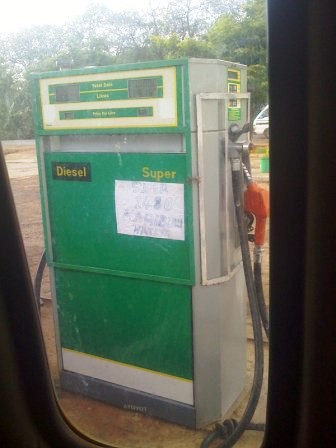
Petrol02
This entry is just a mishmash of observations from Moshi from the last couple of weeks.

Restaurants: they usually have a sink located in the corner of most sit down eateries for you to wash your hands. Right before you eat. The really good food here is Indian, Italian, Mediterranean fusion, Chinese food. Most of these owners are asian, indian, arab. Especially the bigger joints, you don't see owners that are native. The merchants are all expats. The panda chinese restaurant is run by a chinese family from Sichuan, China. It was nice to see some of my own people, finally after 2 weeks here. Sichuan is where they had that horribly large earthquake in China this past year. I ask one of the girls what she thinks of living in Tanzania. She says it's half - half. There are advantages and disadvantages to living here, but china can be equally bad. The competition is less here in east africa, because they are ahead, but they also miss being in their own country even the business here is good.

Internet: There are least 10 competing internet cafes or internet holes in downtown moshi. Whatever you do, avoid the one at the kindoroko. there are tons of viruses. best ones are the one next to The Coffee Shop and Chez Deli and behind the Kindoroko near buffalo.Best deal is the place next to the Coffee Shop (not lounge). It is run by an Indian guy 3rd generation here in Moshi. The place is air conditioned, has plenty of space and the equipment is decent. For every half hour you buy he actually tacks on an additional 9-10 minutes for service. cost is 1500 TSH per hour. The guy speaks perfect english, educated in the USA. The Place near buffalo is called Malaika Internet. Cost per hour is 1000 TSH and the keyboards are a bit sticky but otherwise ok. I tend to write everything in text pad and then copy paste to save time. Lots of computers have viruses, so be on the lookout if you are going to use your USB flash drive. I was able to get it cleaned at Malaika and at the Indian guy's internet.

Chagga/Masai tradition: We learn from Oscar on coffee tours that the Chagga give the youngest born son all the family land inheritance. The youngest will live the longest and should continue it, instead of the oldest. The Chagga live on the hills, closer to the mountains. The masai live on the plains, herding a lot of cattle, wearing really colorful red, blue draped clothes. I did not get a chance to visit a masai village but they wander all over town I saw plenty.

Dalla Dallas: I've gotten a lot braver taking these. I'm taking them every day. In town, the stops can sometimes be comical. The thing chuggs along for 200 meters and then stops. On the highway though, it can be scary. As long as you don't look out the front you're ok.
Advertising: Bulletin boards are a bit misleading, some are posted in the city centre near the roundabout, but the businesses are really far away. A lot of signs are shared with a coca cola ad. The top half is coke and the bottom half the name of a school, for example.

Shops on Mawenzi street: Mawenzi is the main 2 lane street in Moshi. Lots of the shops are own by multigeneration families from India, and Arabs. Many of them of proud of their Tanzanian citizenship; they don't consider themselves citizens of India. I don't know the details about history, but something bad happened about 70-80 years ago that created this immigration to east africa.

Road to Marangu: CCS took the entire house of volunteers out to Marangu for a day trip. Even though my feet were massively swollen, I still went. Didn't hike to the waterfalls but went along. Marangu is the last village stop to the "coca cola route" for those crazy people who want to climb Mt. Kilimanjaro. Ok, just crazy in my mind. I'm not a climber. The last mile to Marangu is off the main arusha highway and is all dirt. Houses along this road are marked with an X to indicate demolition but that won't happen until next year. That's how fast things move here. The market here is amazingly colorful, busy.

Store Supplies & Equipment: A lot of imports from South Africa, Middle East and Asia. Even wine is imported from South Africa. Lots of prepackaged goods are from the Middle east, especially Dubai. Other stuff is imported from mostly China, Japan. A lot of people here seem to know about Shanghai, China - my people! Many of the bikes are imported from Shanghai. They even know how to say hello in Mandarin, although unfortunately I can't speak it.
Power: Electricity can be sporadic. Most Electical is supplied by South Africa to most countries in East Africa and paid by tax payers in South Africa. How weird. How would americans feel, if they had to pay for all of Mexico's electrial needs?

Friday, December 12, 2008

Independence Day & that famous safari city

DSCN0060
13 DEC 2008

This entry runs a bit backwards in time. But it was fun to tie it together.

Thursday afternoon after placement, we went to Arusha, that famous safari city where everyone begins their trip to the serengeti.

Arusha is a NICE town. Let me tell you, after 3 weeks in Moshi, it really is a luxury to see perfectly paved, sealed off streets without any cracks, dirt, or stones. That is Arusha. People say Arusha is dirty, polluted, congested. Yeah, but there is a lot less dirt when you don't have to drive through a dirt road. There are also no crazy chinese/japanese, mexican style graffiti, and heads of Che Guevara covering the dalla dallas here, tons of land rovers, 4x4s for all the safaris. It really is a money town. I count lots of banks. Bank on every corner. Rich town, man. Yes there are touts and people really harassing you to sell their wares, but by now after enough practice in moshi, you know how to talk back to them and deal with the haggling. Prices are ridiculous in Arusha. $30 for a shirt you could get in Moshi for $5 USD or less. They hawk the tourists. It's really messed up. It's as bad as it is at the Great Wall of China where market places are constantly harassing white visitors with their wares. I was so glad I blended in.

A lot of people complained that we couldn't see any trials at the Rwanda Tribunal for the 1994 genocide, but I didn't mind. It was a treat to come out here and see the small business exhibition and other places in town. They have a giant Shop Rite that is a supermarket on par with a decent sized supermarket in the USA. It is approaching 1st/2nd world quality. A bit thin on the magazine side, but I can't complain - especially when I discover that a copy of the economist here costs only 9800 TSH. On Monday a paper boy tried to sell it to me for 13,500 TSH in Moshi. I declined. There are only 2 major magazines that show up here: the economist and Time magazine. As for newspapers, you have a choice of the East African, Guardian.co.uk or Tanzanian national news. All are pretty decent.

Definitely no shortage of US news. Lots of us are getting dresses made by a street tailor near the Kindoroko Hotel in Moshi; we have to wear skirts to placement. Earlier this week, I was waiting for Kindoroko lady to finish my dress, so I sat and read the East African - A new US film about Che Guevara is out and was screened recently. Actor Benicio del Toro plays the revolutionary. Che is big here in Moshi. One out of 8-10 buses in downtown Moshi has Che's head plastered on the front corner of the bus, with a red and green stripe on the side. Why they do it I don't know? I will have to ask but it is not the same situation in Arusha. It is definitely a lot more ghetto here in Moshi. (Thanks to Santiago Ripley for wearing a t-shirt of Che; I wouldn't have otherwise known).

Independence day is on 09 Dec 2008. Most places are, of course closed or open until noon. But there are a few smart entrepreneurs who are still open for business, out of need or knowing that there is good biz. I'm supposed to be due back at the house at 1pm so that we can learn how batik is made; and I wait for Kindoroko lady to finish my skirt. I tell her I can come back thursday to pick it up, but she insists that she haul it out within the next hr. I say ok, then I tell her 10 minutes left.... 5 min left.... The woman is smart. She knows how to move fast and get the sales going. She also have 3 girls that are her assistants. While I'm waiting for her, I buy a bag as well. The ends are entirely sealed up past the zipper ends so I ask one of her girls to do that. I watch as she does an ok, but somewhat loose stitch, so I show her how to do a tigher stitch that will hold somewhat better with wear and tear. How is that for cultural exchange? I only learned about sewing just 6 months ago myself? =)

Kindoroko lady has another assistant cranking away at the iron and evening out the rest of the fabric for another customer. Most of the tailors here are on the street and they have a lot people that just drop in and socialize.

Some rasta guy walks on by and says "Pop it open, Dada*. I want a smoke".

The assistant rolls her eyes upwards, slightly annoyed. She pops the top of the iron open.

Rasta man sticks his ciggie into the iron and lights it up.

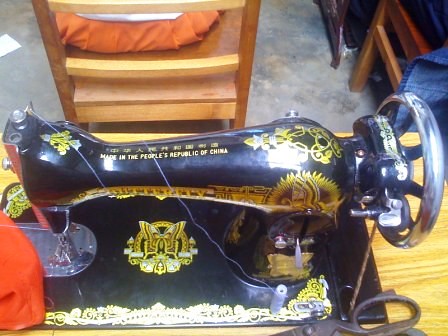
The irons here are all powered by *charcoal*! They don't use electric, even the sewing machines are manually driven - foot powered. Omw. Just had an "in africa" moment.

Rasta man takes a whiff and goes " Dada, you know today is Independence day. We all supposed to love another and relax and do no workie workie. "

Kindoroko lady looks in my direction, like she wants this crazy guy to leave and gives me a tight lipped grin " Okeee kaka... that's fine. sure sure."


* Dada is Swahili for sister. Kaka is brother

Monday, December 8, 2008

Week 1:Case Studies at Ground Level (CCS)

Here in Moshi, I only spend about 1/3 of my time teaching computer skills to the girls in the WEECE vocational school; the other part of my time are spent in field visits.

WEECE loans start at 50,000TSH, or approximately 40 USD to a qualified woman. But before she can get the loan the application process is intensive. There is a check into her background and people who know her locally are questioned extensively, to make sure that she is a reliable individual and will contribute back to the group. There is a progressiveloan ladder which allows larger loans to be taken out after the initial loan is taken out, all the way up to 100,000 TSH. Once she is past 100,000TSH, she moves to a larger loan sub organization called SACCOS. SACCOS was started in 2004 and currently has 79 members.


With every loan, a percentage of the interest paid back actually becomes "shares" which the individuals holds and the money is put in WEECE's bank. She can use the shares in the future toward a larger loan once the inital loan is paid back to WEECE. The advantage of becoming part of WEECE is significant - not only does get a loan at a better rate than the bank, she also receives support and education from WEECE to help her run her business. The WEECE loans are 5 month cycles at 15% interest, in contrast to the local bank which is at a whopping 28%. Because the bank loans are so high, in order to grow WEECE, most of the funds have been supported by corporate or foreign government donations, such as the canadian embassy.


Every week, we visit 3-4 businesses that supported by microloans from WEECE. I think this is probably the most exciting part of my time here. I have experience in business but every business is different, so it's really hard for me to know what my role is as a volunteer. You only get about 45 min to an hour to speak with the women who run the businesses, and to understand how they run the business and what their pain points are. Coming up with ideas on the spot is really challenging but I like it.


But, more importantly - I am writing these stories to illustrate how the loans are used, and how it helps impact their lives. A small loan does make a difference.


In order to visit each business, a woman named Ester takes me to each place. Her job at WEECE is to check in on a regular basis with each of the businesses, and to make sure they revert their loans. She also is there to keep track of the health of each business.


Timber Seller/Poultry feed Business


Timber03

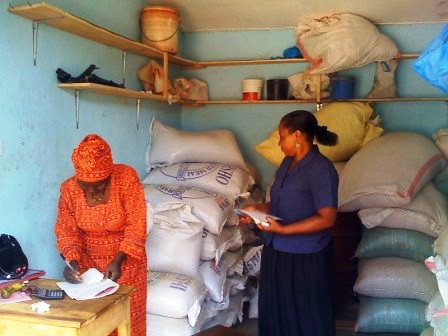
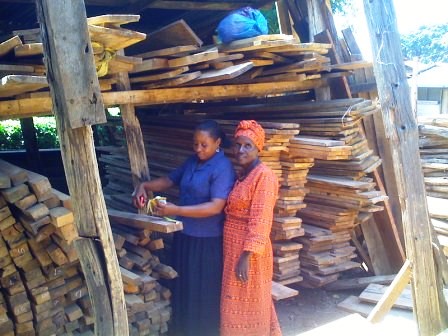
The first visit we make is to a lady called Yolanda Maro who sells feed for animals and timber. She doesn't really speak much English, so Ester acts as my translator for all of my questions. The wood is used mainly for construction of houses and some furniture. It is traditionally a man's job in this area and takes a thick backbone/skin for her to deal with the guys. As a SACCOS member this is her third shop, and is called Matarimo Shop & Timber. She is an example of a WEECE success story. Her shop is located in a good place - on KCMC road - a really busy tarmac road that is close to the main hospital. This road, by the way, is really dangerous. There is no gravel to keep the drivers from going at top speed. By passing cars happens on a regular basis and pedestrians have no respect what so ever. We walked down this street to get to the store and along the way I saw two accidents. It is madness. One large dirt dumping truck has a huge boulder wedged under it. The guy is trying to push it out from under the fender. Good luck to him; if he even manages to move it, the truck weighs at least 2 tons.


Her business is in a niche area; this location is away from the town of moshi, so there is no tax for the chicken feed. She has about 5 different varies of feed, each of varying degrees of quality. The cost for feed is 40,000 TSH/50KG . She also sells feed at 7000TSH/1KG. The feed is for hens, pigs, goats, sheep. Feed is comprised of coarse maize, wheat. It is a competitive industry. She started the feed bsuiness only 6 months ago with 6 different types of feed. Rent for the space is 50,000TSH x 2, because she is using the lot in front as well as the store within.


Timber01

The timber sales has been around longer but the sales is slower. Timber has been in business for 4 years. However the sales has a bigger margin. Her customers are fairly loyal and advertising is mainly word of mouth. Customers are mainly local businesses in construction, some artists, some furniture makers. There really isn't a need for marketing the timber, the material is sitting there by the road and highly visible and most locals know about the business. In order to prevent theft of wood, she has a night time guard and the wood is marked with chalk on the sides and counted daily. The chicken feed is new but again, people spread the availability by word of mouth. She is also a reseller of the large sacks of feed. Her store name isn't on the feed but they don't really do rebranding here.

Why is she running this business? She wants to send her children to school. While education through grade 7 is mandatory here in Tanzania, most parents can't afford the book and uniform fees. In addition, she would like to improve and build a better house for herself and her children.


At this point in time, she is debating if she should take out a new loan so that she supply a special kind of timber that one of her best customers likes. Before we leave, she has a customer visit her and buy some wood. The guy can't pay in full but only partial. She lets him have it and makes a note for the amount he has to pay. Ester tells me that this is a frequent practice here; most people can't afford to pay anything in full - they are too poor - and they are living off of tomorrow's money. As for owing back, everybody knows where everybody else lives, so it is not difficult to track them down if they don't repay within a reasonable amount of time.


Chips and Chicken Business
November 28, 2008

Chips01
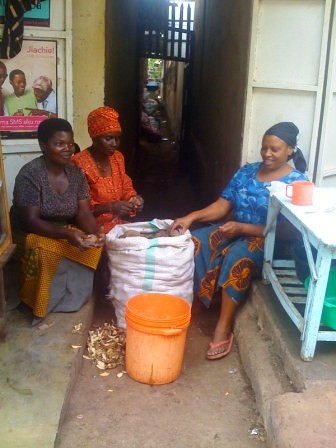
We visit a Chips (french fries for you Americans) and Chicken business today on Mapipa Street (in reality, dirt alleyway). Joyce Simkanga owns this business. She is older, and has medical complications. She was sick for 3 years at one point and completely unable to work. Most of her children are fully grown with the exception of the youngest. He is 7 years old, in primary school. We don't know the details of her illness but it appears to be ongoing. Her feet are swollen and it is suggested that she may have diabetes and heart complications.

The food service/cooking/restaurant business, anywhere, is a lot of hard manual labor. It isdaily works and difficult for someone to keep it up, especially if they are physically weak. Joyce lucks out because her food stall is located in an alleyway right next to KCMC medical school. The medical students come down to the alley to buy lunch and other goods on a regular basis.

KCMC (Kilimanjaro Christian Medical Center) is the best hospital they have here. It is where major surgeries take place and most people can't afford it. You can only afford it if you have money. In Joyce's case, as I understand it, she is special case with fees waived. It is also in collaboration with Duke Medical School here in the USA.

A breakdown of the supplies goes as such: 100TSH for water daily, 60,000TSH for a sack of potatoes, 3 times a week. The potatoes are then peeled, sliced and washed by hand. The business operates 7 days a week, with 1 helper when Joyce can't hold it down herself. It costs 5000Tsh pre tray of eggs, and 5000 TSH/chicken for a total of 10 chickens and 1 tray of eggs that is purchased daily. The materials have to be bought at market every morning, very early and then walked miles to her shop which is a ways outside of town. Trash service costs 40,000TSH per year for pickup. Oil costs 12,000TSH for 5 liters, used daily. The rent is exceeedingly high at 50,000 TSH for just a small outdoor stand approximately 5" x 5" of space, but like anywhere in the world, it's all about the location, location, location. There is a lot of competition for the market space and again, she is lucky to have this prime location.

The chicken with chips is sold at 2000TSH to the customer. Fried eggs and chips are sold at 1000TSH. Sales are typically good, however it is hampered by rainy weather. Job risks is also present - charcoal inhalation and raw food handling. Theplace where the potatoes are cut and washed are covered in flies. However, with a lot of customers, she says she is turning a decent profit. Her main pain point is being ill. She also is running this business to support her youngest who has just started elementary school. Ester tells me that she visits her on a regular basis to lend her a hand.
After we leave Joyce, we walk down the street look for the fresh produce shop we are supposed to visit today but they are not there. Like everything here in Tanzania, you cannot expect anybody will be there on any given day. Perhaps another day.

Saturday, December 6, 2008

Help do something good for Christmas?

Dear Blog Readers,

Thank you so much for taking the time out to read this letter.

As you may know, I'm here in Moshi, Tanzania at the foot of Mt. Kilimanjaro working with a local women's group called WEECE. The purpose of this group is to help empower women by providing microfinance loans and education in business and technology so that they can run their own small businesses and have their own savings. Unlike America, women still do not have equal rights in property ownership, among many things.

You may ask why WEECE is not part of a larger microfinance loan organization such as KIVA, or OptInNow, which supports individual women in developing nations. The truth of the matter is that in order to be a part of a larger organization, the local NGO must already microfinance more than 600 to 1000 women.


WEECE only has 244 members.

At the grassroots level, Funding is really hard, non existent. Don't expect the Gates fund or the Global Fund to even look in your direction.

Over the past 15 years WEECE has been growing slowly and successfully but the growth is painfully slow. The reason why is that funding for microfinance projects are shaky and bank loans are a whopping 28% interest rate. WEECE only lends at a 15% interest rate which is fair. The majority of their members do repay their loans and are moving up the loan ladder.

However, the money to fund WEECE has been mostly grant and fundraising. The problem with both is that it is not consistent. And when the money dries up, it's really hard to expand.

Since I've been here, I've worked out a business plan to acquire sustainable funding for WEECE that is consistent.

The plan is to market locally produced hand made goods with a small profit going to weece.

We would eventually like to build out a site that is on the weece website; however it is next to impossible for me to do that here in moshi. For the time being, we are going to bootstap sales of local goods by posting them on ETSY.com which is a market for handmade goods. They would make excellent Christmas gifts, and hopefully will arrive on time the sooner your order is placed!

I will be here in Moshi until Dec 19, and will be working with WEECE to catalog more goods from businesses that they microfinance to put on their future web shop.

As the payment is currently made to me by paypal, I will pay WEECE directly their profit for every shipment that we make.

Just one item will make a difference

The site can be found here: http://christinasc.etsy.com

Please let me know if there is anything you'd like to request.

I can also send you Really good Kilimanjaro coffee beans in 500 gram packs for $15USD - that includes the cost of shipping. Just let me know, and pay by paypal. Was unable to list that on etsy because it's food.

If you can think of any friends who may be interested, please do forward them this post!


With Best Regards,
Christina

======================

Spring 2009, Shop Postmortem 

We made a lot of sales in the four weeks or so I was in Tanzania! Most of the items were sold via paypal and shipped by the local post office.  I collected enough to send WEECE back $250 USD in NET Profit from a few weeks of work. That translates into 1 microloan or approximately 325,000 Tanzanian shillings. I'm sure had I stuck around Tanzania bit longer I would have generated even more sales online as many of the items were Obama Kangas (cloths that had Obama's face printed on them) that sold very well as souvenir items