Showing posts with label africa. Show all posts

Wednesday, January 6, 2010

CCS Moshi : What to Pack, Safari, Climbing and Extra Curriculars.


CCS Moshi : What to Pack, Safari, Climbing and Extra Curriculars.

What to Bring:

Clothes: Weather is generally warm and humid. There are times when it will rain. The dirt roads will flood if that happens. Around Moshi, you will rarely need a warm jacket or long pants unless you are on the plane where it can get cold, or if you are going to climb Mt. Kili or Meru.

"Girls... bring either yoga pants (short ones) or stretchy shorts (spandex, bike shorts) or something like that to wear under your khangas here. You do not need to bring a tons of skirts as you can buy material here which is basically a khanga. You don't even have to get anything made as you can just wear it like sarongs. You will understand when you are here. Also your T-shirts get stretched out from washing them so bring tanks to put under"

"If you have extra room in your luggage and clothing at home that you dont need anymore, there are great places here to donate clothing. Most people leave a lot of clothes behind when they're packing (mostly because of all the things they bought here that they need room for)."


Shoes: I would defnitely bring one pair of good walking sandals, such as chacos or tevas. It would be a good idea if these are washable, as your feet will be filthy from walking on the dirt roads. If some of you want to go running in the mornings, be careful as there are lots of rocks and its very easy to sprain an ankle.


Snacks:


"Bring snacks you like such as chocolate, candy (enough to share if you want). "

There are now at least two supermarkets that will sell most snacks, although largely cadbury's and some south african chip brands, as well as ice cream. Coke products are prevalent throughout, however, in many places they don't let you take the glass bottle with you; you have to drink the coke and leave it at the location. Most 1st world luxuries are likely not available, but you may be surprised that you will likely find the equivalent of a 7/11 store, plus more. In addition, if you buy locally, you are contributing to the local economy in a good way.

Entertainment:

"If anyone has Ipod speakers those come in handy. Sometimes when we need a TV fix we all pile into one room and watch a DVD so if anyone wants to bring a few of those that would be great. Also, TV show seasons are a great thing to bring. " Some people bring their laptops so that they can watch their DVDs on them.

Money:

"In terms of money, I would recommend bringing bigger US bills, 50's and 100's, because they have a better exchange rate."

You can also get money from ATM's downtown anywhere

Medical:
"DEET bug spray is a good thing to have. Especially since with the short rains this season, its getting buggier. My bet is that you can find OFF bug spray in Target and other similar stores. There are different types of OFF with different levels of DEET."

There is also a ton of leftover bug spray from previous volunteers as well as hydrogen peroxide and other first aid in the bookshelf at CCS Karanga.

The most effective bug spray I found was from REI - the non-DEET kind. DEET oddly, is not as effective; I suspect that some of the mosquitoes have started to become resistant.

Safaris and Climbing

CCS is contracted to Bushmen Safari's. They do weekend safaris and also Mt. Kili/Mt. Meru climbs. For Safari's it is not possible to make a weekend trip to all 3 parks: Ngorogoro Crater, Lake Manyara and the serengeti. It is simply too far. You can do solely the Serengeti in a weekend. Or only Ngorogoro and Lake Manyara. If you want to do a safari that is longer than a weekend, please contact them directly. If camping is not your thing, be specific about your needs and request lodging or a lodging upgrade during your safari. Rains may occur during your safari and your tent may be flooded. Be sure to have some container to protect your electronics if you are bringing expensive kinds of electronics. (Personally I wouldn't bring anything precious or an heirloom when traveling but some people can't bear to part with their most precious belongings.....)

You can find information about them here: http://www.bushmenexpeditions.com/

If you choose to go with another safari company, it is wisest to make sure that they are TATO certified for safety standards and training. Driving in Tanzania can be exceptionally dangerous and it is your life that is on the line. The major trauma cases that end up in the hospitals here are Car Accident victims and Burn victims from cooking pots.


Getting to Zanzibar

Plane flights to Zanzibar may be canceled or consolidated at the last minute. Please DO NOT expect to be guaranteed a flight friday afternoon after your placement. Your flight may be consolidated with AM flights and then you will be forced to miss placement, which is really a disservice.

It takes about 1 full day's bus ride from Moshi to Dar es Salaam. From Dar es Salaam to Stone Town Zanzibar, it is either a 1.5 luxury fast ferry ride or a 3 hr standard ferry ride. There is some distance from the bus station to the Ferry, so you will need to take a taxi in between. If you leave in the early morning in Moshi - around 5 or 6 am, you may be able to catch the last ferry, otherwise you will have to overnight in Dar es Salaam.

Transportation to other parts of the island on Zanzibar may take anywhere between 1-2 hrs Taxi ride. Consider staying overnight in Stone Town before making your trip elsewhere around the island.


--------------------------------------------

The above quoted excepts by Talia Cohen, previous CCS volunteer at Karanga in Moshi. The rest are my comments with more information.

Sunday, March 22, 2009

Final Notes from nearly 5 months in Africa

Since reaching America I've noticed:
  • Food tastes like crap. starbucks tastes like water and the milk terrible and flat. I had to hold a chocolate muffin to my nose, literally to smell it. nothings really 100% organic here, even though its labeled as such
  • Everyone does their own thing and doesn't stare at me anymore.
  • There are rules. Lots and lots of rules. Everyone lives in a box. And with a clock. and is super dependent on electricity.
  • Clean and antiseptic. My feet are clean for once.
  • Some people make a lot of assumptions about Africa; they've never been there but assume they know what it is, including telling me what I should think about the continent after several months there. Eh, to each their own.
That's all for now. Thanks for reading if you've been doing so the whole time. There is always going to be that story I can't tell online. Actually a good part of everything I did in Africa I did not write about here. But if you know me, and want to hear, I'll be glad to share it sometime.

But, until then,

Tchau. Kwa heri. Au revoir. مع السلامة. Adios amigos.

Saturday, March 21, 2009

Arab, Euro, African Collision

DSCN1999
The worst hour of the day for a plane flight.

A word about the Accra airport at 2:00 am... There is hardly anyone awake, and because I was early for my flight - the only flight that leaves after midnight from Accra - the customs line was completely deserted and silent.

Am I supposed to walk straight through and not get my passport stamped? I wander through to security, where two guards are cracking jokes and playing poker.

"No ladyee, you have to go back to customs..."

I protest, "But nobody is there!"

"Yes there is, you just gotta go back there and find them!"


I walk back to the customs area and hear nothing but the sound of dripping rain from ceiling to bucket and the faint hum, no wait - Snoring!?! From this angle, I see a foot sticking out from behind the customs booth. And, as I get closer, I see one mattress.

And then, two, three, more mattresses on the floor, each with a customs agent barefooted, snoring and sprawled out on top!!!

So here I am, unbelievably kicking the nearest agents' mattress and hissing, "helloooooo I need to exit Ghana, can you please stamp my passport?"

The tiny male agent - only about 5 feet or so - finally gets up and wobbles around in a drunken sleep stupor, pops his hat on sideways and wanders to one booth, only to find that it's not his booth.

Then he steps to the adjacent booth, realizes he's missing his stamp and then wanders back to his neighbors' booth fumbling around for the right stamp. Finally after 5 minutes of fumbling and bumbling he stamps my book and collapses back in a heap on his mattress.

Security was a no brainer after that.

Oh my Word. Only in Africa, I suppose.

DSCN1710


***********


Royal Air Maroc leaves Accra, Ghana at 3:40 AM, then hops over to Coutonou, Benin, a 50 minute flight before flying back to Casablanca and arriving at 9:30 am. We land in Coutonou somewhere around 4 am... the plane doesn't take off again for a while, until maybe 5 or 6? Then the lights go off. Some hours later, I am rudely shoved awake and the tray table slams down - "Le Petit Dejuener!" I am barked at to eat breakfast.

So in one night, I am rudely awaked 3 times, and exhausted from the heat, then the cold, and the shuffle. Horrible ordeal. I will give credit to Air Maroc - their planes are clean, fairly well maintained and the staff speak french, arabic and english. Although the english at 4 am is so fast and slurred sometimes I can't even understand it.

We arrive at Casablanca airport and immediately the difference is there; its much like a european airport. Few people on this flight are actually disembarking here; most are connecting.

One Ghanian complains about lost luggage... they seem to lose the luggage here a lot. It took me nearly 2 hrs to get my luggage. He got his earlier, and it was lock broken, thoroughly searched. I know my pack was checked in at the same time; there is no reason for me not to get it. I know they are testing my patience. So I wait.

It pays off. I get my luggage by 11:30 am from the transit staff who look at me sheepishly. Much of the conversation is french/arabic. They are a bit standoffish. a lot of angry people waiting for their luggage. The line is long. I am ready to fall asleep.

I decide to take the train into casa from the airport - its well connected, convenient. Most people who run businesses speak english these days, with a few of the older generation speaking french only. it pays to know french, even if its really bad. The train costs only 35 Dhrm into the city, instead of 300 Dhrms by taxi.

At this time of year, march, morocco is really green, pastoral.

Casablanca

The train dumps in the city at this station called Casa Voyageurs. It is maddness again, but with light skinned people; they are suddenly hassling us, demanding where to go. I am really fed up. I just want to get to a place and sleep. I don't care and I end up paying probably triple? but after all of that it doesn't even matter anymore. There are two classes of taxis, the small red ones should operate on meters but they harass tourists that have no idea with a prix fixe. With the french influence, these taxis are all tiny renaults with a flat yellow sign on top that reads "Petit Taxi" in french and arabic.

IMG_0885
The taxi driver is a little bit of an old kook. He doesn't know where we're going, even though he has the address. We drive across the streets and half way across a main boulevard he slams on the breaks to avoid two giant white horses, completely decked out with arabian seat covers, and a old man and a young boy riding each in traditional moroccan costume. We detour and drive into this area with lots of arches and shops. He pulls aside and says ' wait here '. I am dazed. There are people sitting in a cafe drinking coffee on one side, with silverware and rugs for sale. On the other side a donkey tries to squeeze by in a street that really looks like its meant for pedestrians only. 2 minutes pass and he's back. We drive on, through twisted streets and then on to large boulevards. All the buildlings here are white, they look a little like the ones in Dar es Salaam but in much better condition. And the climate for me, is livable and breathable - it is dry, cool.


IMG_0878


I don't spend much time in casa, actually spend most of it trying to catch up on sleep. I only head to the mall to get some toothpaste and that is it. Just walking around - It is really hard to tell who is or isn't a moroccan. A few times Spanish or Moroccan could be interchangeable. Lots of dark swarthy looking men. Arabic looking women.

I'm on the train to Marrakesh the next day. Its a 3 hr ride south. I meet two extremely tall dutch guys who are also going there. An older brother and his younger teenage step brother. We have two hours to kill and they tell me stories of traveling through Turkey.

Marrakesh
DSCN2004
In contrast to the overcast cloudly and mildly polluted casablanca, Marrakesh's sunny mediterranean climate is a welcome change.

We get to Marrakesh and these two brothers look kind of lost. I know where I want to go; there is a great hostel here called Equity Point - which actually in my opinion is probably the best place I stayed, period. It is really more like a Riad, than anything else. The taxi driver is demanding 50 Dhms. I am saying, are you kidding. The two brothers look at me like they don't know how to negotiate. I keep bargaining. The guy is a hard head. I get him finally to agree to take us for 40. It should be 20-30. And I know with my directions that he can't get us to the door; I'm staying in an area where no cars are allowed, close to the famous Djemma el-fna.

Djemma el-fna.

Completely blew away my expectations.

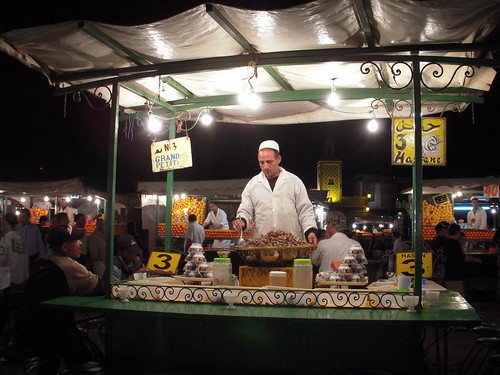
This is a place to get lost. if you uncertainty bothers you; it might be a good idea not to travel here... The real life turns up after dark. That's when all the food stands pop open. everything from Tajine, shish kabobs, snail soup, sheep heads, to chocolate mousse, carts full of french pasteries.... you can sit here and eat forever. The food is delicious, and cooked right in front of you. Of course the sweets are good - a lot of french influence on the cuisine.
DSCN2024
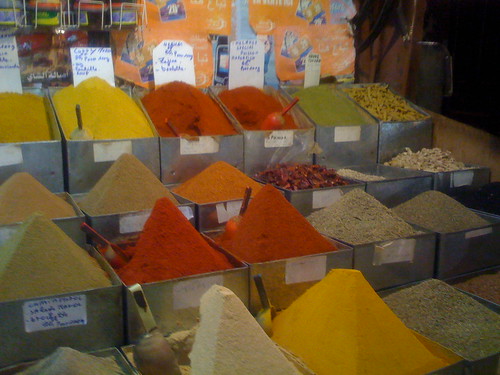
Plus, the entertainment.... it is a veritable circus of sensory delights: snake charmers, henna artists, story tellers, belly dancers, drummers, bands, people in traditional costumes strutting around, shishas blowing about. If you get bored by the happenings in the middle of the square you can always entertain yourself by shopping in the maze of souks surrounding the medina. There are spice racks, dried fruit stands, orange juice vendors, artisianal pottery, everything moroccan.


What amazes me, is despite all the foot traffic, the streets are really clean, well lit and safe to wander around. A little crowded at times, with the motorbikes, vespas, donkey carts and pedestrians all competing to get by. But it adds so much character to the place. Its not just for tourists, locals come to the souks and eat in the Djemma. Some of the storytellers, herbal fetish vendors tell their tales completely in arabic, and are surrounded by moroccans listening anxiously; of what I don't know, unfortunately.

  DSCN1996
The people, amazingly diverse, friendly. The women are allowed to dress liberally, or traditionally, their choice. As with most islamic countries you have the call to worship from the minarets, but its not "in-your-face" like it was in tanzania. They don't blast it so loudly you can't sleep. In fact, I didn't have a hard time sleeping there at all.

I did get sick for one day unfortunately. The second morning in marrakesh I ran a fever. I was really scared at first, because I wasn't sure if it was malaria from ghana. But after several liters of water, rest, and tabs of the local vitamin c fortified asprin, I was better within 15 hrs or so. We hit the hammam the next day when I felt better; this was a really neat experience - to be scrubbed, steamed and massaged in a bath house with other women; a tradition here.

DSCN1997 If I could trade another 2,3,4 weeks to stay here in morocco, I would. But, plans change.... I promise myself I am going to come back here to finish my visit someday.

My plane leaves for the states from Casablanca. On my return trip, when I get to the train station, I ask for a metered taxi. In fact, I start demanding it and everything en francais - " Il faut que vous tournez le conteur ou ..... pas irai!". The minute I say it - all the hassling taxi drivers look the other way. Some shake their heads. Plus, I only want to go a short ways. No interest. Aha! I keep asking for it, and finally get one that will take me. He has another lady in the back seat and appears to group his rides....


After confirming where I want to go, he runs off to get some change and says he'll be back in a minute. A hear a small voice from the back of the taxi, she says "er, Do you speak English?"

DSCN1992

Ah, yes! wow, do I speak english? So I find out that the lady in the taxi is actually a local casablancan - who insists on a meter - because they would otherwise overcharge. I tell her I came from Marrakesh, and she actually the same - She asks how long, and I said I was only here for 5 days. She said it was too short. 5 days is too short for Marrakesh. Wow. I feel the same. I could spend a month in Marrakesh and it would make me happy.

Wednesday, March 11, 2009

Americans, History & Ghana

DSCN1698Akwaaba. Welcome to Ghana, is what the sign at the airport says. I arrive with a bit of intrepidation because I have NO idea what Ghana is like. Except that I know that Marci has moved here recently. Something about traveling for several month just emboldens a person lots so you forget the "what-ifs" and just go.

The plane is freezing cold but the minute off the flight; it is a goddamn sauna. And it's nearing midnight. Customs is long; there's a separate line for ECOWAS, but even the south african shuffle though that line for West Africans; so typical I think to myself. The taxi drivers don't know where my hostel is. So Typical. But I am prepared. Armored with info. I figured this as much because I had the same trouble in Pretoria a week ago. I have to read the directions and simultaneously get smothered and hit on by the taxi driver. It is all in good fun. I just roll my eyes. Just get me there. No more talking please. I need sleep.

Accra

I think of East africa, and I brace myself for the hassle in the streets, touts and people following me anywhere. BUT - it doesn't happen here in Accra. ok, maybe only 10x less. I will explain why .

It is a lot hotter here in Ghana than it was in East Africa. I don't know if it has anything to do with the time of year but apparently this isn't the rainy season. 91 degrees Farenheit on average every day in ridiculous humidity. Rain is sporadic, and it doesn't stay wet long. People run around the street with bags of plastic water stuffed in their mouth as they work on the streets. Water in bags. Ice cream is also sold in bags. Of course you can get it in a bottle or in a box, but the cheap stuff is all in a bag. People chew off a corner of the sack, spit it out and then walk around with a bag stuck to their mouth.

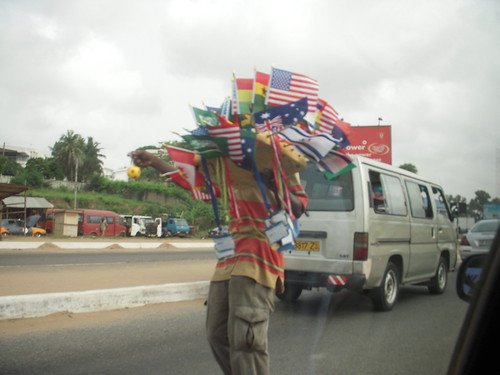
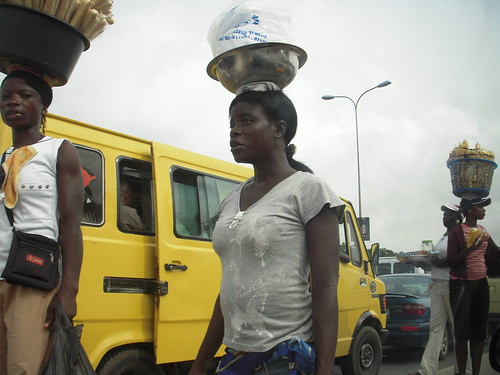
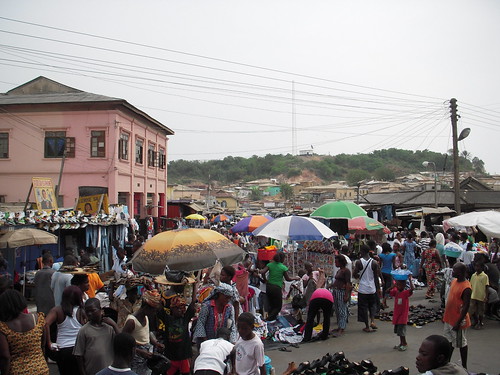
These bags of water, ice cream, and more are all sold in traffic to ward off the heat. Accra has a huge traffic congestion problem. By midday expect most of the major streets through the city centre to be bumper to bumper. Cars, trucks, trotros, coaches, back to back and neck to neck. With a large percentage of the population unemployed many people make their living hawking goods on the street, as in many parts of africa. But compared to east africa, I have never seen such a large group of people and with so many diverse items sold in traffic. They really take advantage of the standstill traffic to sell stuff to people sweltering in the heat. You can buy everything in traffic.... super glue, socks, pants, notebooks, laptop cases, french-english translation dictionaries, chips, popcorn, lunch, drinks, flags of the USA, Canada, australia, ... they seem to like americans a lot here.

You just die in the heat. I fork out a 5 Cedi bill for a giant bottle of water. 4 Cedis come back through the window. I give the driver 3 Cedis, "that's for you" I said. The driver is sweating buckets, and the 3 Cedis go back out the window to buy several packs of ice cream and water. Ah, so that's where your money goes. I lay in the back, and wish for some air conditioning now.....

Accra has become a major business center. Also, LOTS of expatriates here. Tons of volunteers, peace corps, university students from abroad, hospital exchange programs, business people from the USA, Canada, Lebanon, India.... etc etc. It's a very safe city. The traffic can be a bit hectic and of course you have tro-tros ( their bus-taxi equivalent ) but I feel a heck of lot calmer here. People are pretty easy to deal with you don't have as much inflated prices for foreigners (oboroni - person who comes from beyond the horizon). In fact, I got into a tro-tro today and paid the guy 20 pesewas, and he gave me 5 back in change. I didn't want the change. I gave the 5 back to him. They see so many volunteers, business people and academics who come to study abroard, they don't bother trying to hawk more money from foreigners. Unless it is a taxi driver and a few people selling goods in more touristy markets.

But as a whole there isn't much tourism here; there isn't the draw you get for east africa, because most of the animals have been killed off. People come here for different reasons. They come for the drumming, the music, the culture, and the people. The people here are very nice, and it's really safe. It's squeezed in between several francophone countries; you can hop across the border to Togo, Cote d'ivoire and they're completely french.

The money here was recently revalued and the current exchange is 1.4 Ghana Cedi's to 1 USD. 100 pesewas make up 1 Cedi.

Accra is an odd place. Before independence, it was a British colony. But here they don't drive on the other side of the road. They drive on the same side as we do in the states. And everybody speaks English.

However, despite the English; few people here know where anything is. Is it the accent? No, because they know where major landmarks are. But once you start getting specific, like street names, places that are new or off the beaten track, they look at you and say they have no idea. After a week or so, it's not that they don't understand you; they really don't know street names.

The people here - they remember places. they remember circles, big places, gas stations, supermarkets. But they don't know the name of the street, or the number on the buildings. Taxi drivers will just look at you blankly and drive past if they don't know where you want to go. No, you don't want to make any money today?, I say. Funny.
DSCN1873
Cape Coast
A must see if you are interested in African American history. This town was once the capital of Ghana. In the colonial days, Ghana was known as the Gold Coast. Literally there is gold here, underfoot. Ghana also produces a tremendous amount of cocoa, like its next door neighbor, Cote d'ivoire. But, despite this, you won't find a lot of chocolate made here; most of the chocolate is made in belgium, switzerland. Something about politics and subsidies and facilities. I won't get into that here.

Every major european country wanted a piece of Cape Coast - they fought endless wars over it. Strategically it was really valuable. It was the major hub for the slave trade to the americas and the caribbean. The dutch, The portugese, the french, the swedes, the british.... eventually the british got it and controlled it and built this fort to export slaves, a place called Cape Coast Castle. Its' actually a well built fort; and honestly after seeing Zanzibar, the space that the british kept slaves in appeared to be a lot better than Stone Town Zanzibar. That's the one thing I hated about stone town; i went to a lot of the historical sites and through the winding streets. It had such a contorted twisted horrible feel to it. It really left me uneasy, sick. The arabs traded slaves there as well; to where I don't know.

Some americans come every year to visit cape coast castle, and place rememberances there within the slave dungeons. As for celebrities; word has it that Serena Williams visits Elimina every year - another fort/town about 10km from Cape Coast.

But, as for Independence from colonialism.... the roots started here in Ghana. Ghana won independence in 1957, on March 06. Last friday was the 52nd year of independence. Independence celebrations are like the US, a bit more subdued.... but they do deck out the entire stadium and downtown and have a giant parade. People are very patriotic, lots of gold, red and green. The first president of Ghana, Kwame Nkurmah is known for inspirating Martin Luther King, Jr. and the civil rights movement in the USA. Also, W.E.B Dubois - first black american to graduate from Harvard is buried here. He actually moved here in the last two years of life to work on chronicles of african countries and to work on "pan-africanism". They were really trying to build a united Africa - one africa, not the africa like you see today with many small countries, cut up along colonial divisions... What they wanted was something massive like how China is. But unfortunately there was a lot of fall out. Also Nkurmah was exiled in his last days, some say because of mismangement, but others say because it was a CIA plot.... of the interesting characters I've met, I heard that from the son of the guy who worked as Nkurmah's personal press - reporter. How true I don't know.

Cape Coast is a small town and actually pleasant to walk around....admist the goats wandering the street and the sewage, but that's another matter. It is significantly cooler than accra, and little traffic. Outside of Accra it can be difficult to get around because there aren't as many trotros and you have to take a taxi, which adds up fast.

My gut feeling is that Ghana is still extremely valuable as a strategic point for the US. I went past the US embassy and it is one monster of a structure. Really ridiculous how obscenely big it is. Also ran into some marine corp soldiers, although they weren't soldiers...they were the marine corps band! Their only purpose - the entertain the troops. Thanks. so that's were our tax payer dollars are going.

If I had more time, I would have traveled north to Kumasi; they say there is a huge market there, and people say you can see more of the traditional ashanti culture there; although the bus ride was 5 hrs and I was too lame for that.... and then further north to Larabanga. Larabanga is one of the oldest mud structures - it is a mosque, and is known as the Mecca of West Africa.

*******

I'm getting a bit tired of traveling. Being here in Ghana is making me somewhat immune to really enjoying africa, I feel like I've seen enough of the same thing over and over again.

Originally I had planned to go home 2 weeks ago, after vic falls. I extended it to come to Ghana. Really ready for something else, preferably home? Originally I was considering a border hop to see more of Francophone west africa - to lome in Togo, but I am so tired I'm staying put here in Accra for a few more days. My plane leaves to Casablanca on Saturday night at 3am - that's tonight.. Not looking forward to that.

I had plans to go through Europe before heading back. But the last couple of days have been lethargic..........I can't describe it - perhaps its the weather here, but I don't have the energy to go exploring, to brave the maddness of the crowds, the excitment isn't there, I have seen TOO much africa, yet at the same time, I am realizing, ironically how LITTLE of africa I actually have seen.

I am feeling really lucky that I've been able to see so much so far, but at the same time; I think I have overdosed on shooting from the hip and "just going".

Keep in mind, all of the traveling I've done since the beginning of this year has been ALONE.

yep.

Nobody is going to any place with me. Scary thought. It's so dangerous, people say - that continent africa. But its not entirely, you *can* be safe and just play it by ear. Talk to lots of travelers. Look dirt poor. Pretend that you work for the Peace Corps or just look the part. Some people think I'm nuts. Sometimes I think the same. But the rewards of doing this by yourself is really great - reap massive rewards. And see what you really want to see. Meet lots of really interesting and great people along the way. Make some awesome friends. Feel crummy when you have to part your ways. And then meet some crazies along the way. Feel relieved when you get to ditch them. And not feel guilty.

Things you learn on the road, you can never learn in school. And I mean it. 4 freaking years of university education will never teach you how to live like this, and how other people live in different parts of the world. An education from books won't teach you how to shoot from the hip; move to another place when ever you feel like it. Or to deal with touts, and the hassle and to qualify travelers and people on the road at the drop of a hat. You learn to go with your gut. And to listen to the locals and to find out what's there under the surface that the ordinary tourist doesn't want to know or doesn't care to know. There are days when I've literally packed up at 4pm and decided to haul ass to the next town instead of staying here because word is, the party's better over there. haha. Feel the freedom of not having to be locked down in one stupid country with one stupid set of rules that you might not like today.

Unfortunately my curiousity is dying. I just crashed this week. Hard. I have one more place I must absolutely see, and then...I caved. I have mixed feelings about returning to the states. But you know, there is no place like home. Today I just booked all my tix home. Yes, this whole time --- I have no valid return ticket. Until now.

Oogah.

A week to kill, so I go visit Soweto and the Swazis

Week of February 21 - 28

I get super lucky and manage to get all my paperwork in on monday morning for my visa to Ghana. It says 3 working days, but like everything here, it would be longer. So I budgeted a week to stay in South Africa. I can get my visa back within 24 hrs, actually for an extra 20 USD.
With time to kill, I get out of Pretoria to Swaziland, now that I have a passport.

Swaziland

It looks like South Africa but is governed separately. There is also a swazi king who gets to pick a new wife later this year. He already has a dozen or so wives. While the government is independent from RSA, they still share a lot of the same infrastructure. One thing that is obvious though is that swaziland is a very homogeneous culture. They all speak their own language - swazi and take pride in being an independent nation. There are plenty of NGOs that work with local communities in various crafts to help provide a living to large groups of people. The money is different but it has the same value as the rand. I meet some peace corp workers on break. I hear they get updates on their cell phones for potentially dangerous places to avoid in swaziland.

Soweto

I did a short tour of soweto before climbing on my flight to accra. We learn about the history and its role in the anti-apartheid movement from our guide. Later we visit a museum named after a young boy called Hector. He was one of the kids in 1976 that was gunned down by the police because he didn't want to learn Afrikaans in school. Really horrifying the stories and documentaries. Afrikaans, a language that is similar to and created by the dutch settlers, was forced upon the colored & black populations as a form of control. We also saw desmond tutus and nelson mandelas homes. Very touristy - tutu's backyard.


Some short notes about Zambia

While I was in Vic Falls, I did the border cross to Zambia in order to get supplies, like food, money, etc.

Because of the economic crisis in Zimbabwe, there isn't much to buy on the street. Most of the people cart stuff over the border

Seen at the border: Long line leaving Zim. Short line going back in. The border post has a special offer - no cost- for nationals who want to cross over to zambia for the day before 6am. Apparently so many have been going back and forth over the border to get goods from Zambia, they were trying to divert traffic.

By 10am, the border on the Zim side was packed. Waited about 2 hrs to get over to the other side. No touts, few money changers and relatively peaceful. The most excitement we got were from some of the baboons who kept running around trying to steal bread from people's bikes and bags.

The distance between the two border posts is pretty long. I would estimate that it is a 1km walk between the two, but I could be wrong because it was so hot.

It is cheaper for americans to enter Zimbabwe and then go to Zambia, then the reverse.

If you enter Zimbabwe, the USA single entry is 30 USD or 210 Rands (21USD).
Once you are in Zimbabwe, to enter Zambia it is only 20 USD for a day visa. They didn't even look twice at my visa on my way back into Zimbabwe and didn't ask for anything.

If you enter Zambia, the Visa is 50USD, and then to cross the border to Zimbabwe, it is another 50 USD.

You can walk the crossing, which includes the bridge over Vic Falls, and do a bungee jump along the way, or be lazy and cab it over to the Zambia side. Once you are past the Zambia border check, it's a taxi for about 2-3 USD to get to Livingstone, the nearest major town in Zambia.

During my walk across, I meet a woman who from Zimbabwe - she lives halfway between Harare and Bulawayo and is on her way to spend a month working/living in Namibia. There are a lot of people who are doing this. I help her carry her bags across the border. From talking to her, I'd estimate that probably a good 80% of the country has exited to any of the 5-6 neighboring countries for either temporary or permanent work.

I'm not familiar with livingstone, but she is; so we split a taxi over to the town. I ask for a place to shop and an ATM, she points me out to this giant 1st world market thing that looks like a Stop and Shop. I'm like um.... that's ok. we have plenty of those in the states. Let's go straight to town. So that's what we do. She is going to take the bus from Livingstone to Windhoek and then go from there.

There are nice commercial markets in Livingston. It is fairly busy and business is good. Tons of taxi drivers and a thriving market. I also visit a local market and hunt around for items. It is cleaner than the ones in east africa. I stumble across a zambian that actually speaks Swahili. Which is fair, since the tanzanian border is not that far away. I buy a lock from him because I lost mine. In contrast, the Zimbabweans that I run into haven't heard of Swahili....it sounds like chinese to them.

Monday, February 16, 2009

Electronics while Traveling throughout Africa


Electronics while Traveling throughout Africa.

At 4:08am on February 16, 2009, Christina Chu said…on the CCS community site

Hey Madeline,

I'm so envious you're going to Dharmasala. That is next on my list. Although my CCS ended in December, I am still traveling africa. I'm in Namibia right now. As for a laptop, I wouldn't bring one, but that is because i'm traveling so long haul... going on now for 4 months. Plus in africa, it could easily be stolen. There are abundant internet cafes.

As for cameras - I would bring a cheaper digital one, unless you're a photography enthusiast. I always worried about having an expensive long lens camera stolen or broken, but that is just me. One memory stick in the camera is enough. You can always buy USB sticks as you go. For quick pictures find a computer with microsoft picture manager and compress the pictures down so that you have a backup copy that can be quickly uploaded to flickr.com or picasa.com. This is in case you lose your high res pictures on USB sticks.

The only other electronics I brought were a few USB keys and my iphone which was indispensable. If you can afford the bill, you can get mobile internet off an iphone anywhere in Tanzania.

The USB keys are GREAT insurance against power surges/failures -Example: if you are working on a document, be sure to save the document as you're writing it ON THE USB key, not the computer's hard drive. This way, if the power suddenly cuts out you can walk away without losing any data.

In addition, you can use the USB keys in all the Internet cafes; the keys are lightweight and paying just $1/hr (on average) to use the internet at a local cafe helps contribute to the local economy. Take care that the computers you are using have anti-virus protection. Many places don't yet.

East Africa as of summer 2009 has High Speed Internet by ocean fiber optic cable. However I don't know how far it has penetrated. There is wireless depending on where you stay - some hotels have it.


Since you're in india technology access will be substantially easier in major cities as you have hyderabad in the south - tech capital.

I have been living out of one bag - 65 Liter Osprey backpacker for the last couple of months. When i run out of room and i want to keep things, I go to the post office and ship it home. It really is a great experience - using the post office because you really get to learn how things work there -- you'll see.

I brought my iphone - indispensible. If you have a USB charger that is all you need. It is more of a pain to use wall chargers and these take up more space, since i've been going through so many countries, but a USB phone charger wil work on every computer you run into, which is fantastic. Often I will just buy 2 hrs at an internet cafe, and use the internet to blog about everything, transfer, compress and upload pictures, check email and simultaneously recharge my iPhone.

Don't need water purifiers. Just malaria tabs if you are in the region. Pack warm clothes and light weather clothes. Close toed shoes and open. EVERYTHING else, you can buy as you go, unless its prescription like contacts. Of course this is personal because I can live without my entire makeup bag, no problem. The 3rd world is more developed in commerce than we think they are, which is amazing.

Hope to see you in san fran. please drop me an email or comment on my blog sometime, i hope to hear from you.

Tuesday, January 13, 2009

Out East and Down the Coast

Moshi - through Jan 3 - 2009

I spend NYE with the volunteers from my house here. We have a grand old time. I feel like I've returned home. I left my heart in Moshi. Michelle isn't feeling well and then some, so I leave her to recuperate for the next few days before she starts work in Moshi.

I learn a couple of new things here in Moshi.

Dar es Salaam is a bad place to import goods to. The locals would rather drive to Mombasa and then cart it over the border. Damn socialist government.

Remittances from abroad is difficult. Most citizens don't have bank accounts or credit cards. Bank transfer fees are ridiculously high. Money going out of the country is easy, money coming into this country not so simple. I spend some time trying to educate a few on import/export business, but I don't know if it is worth my effort of time. Does my effort even matter anymore? I realize I am getting jaded. I need a vacation.

When Africans want to move FAST - haraka haraka - they really do move FAST. No Pole Pole Normally you can a ticket from Moshi to Dar the day before or the morning of. After the New year, there weren't any tickets, not for two days after. And its not just Mzungus (foreigners) traveling. These are locals. Apparently most of them go back to Dar for work and return to Moshi for the holidays. There is a line in front of me of natives trying to get tickets the day before and they are also turned away. It is early in the day and I actually have a local Tanzanian do the asking for me, but that doesn't even work. My suspicions are confirmed when I visit a bookstore in Dar es Salaam the next week and hear the same story from the fellow work manages the store; his hometown is also Moshi.


Dar es Salaam - through Jan 5, 2009, & Jan 11

Originally I was going to join two volunteers to make the trip to Zanzibar but I miss getting a bus ticket. Perhaps that's fate. Because I went solo, I decided to stop in Dar for a day and see the commercial capital. From the 12 floor of downtown dar - city centre. It is a mess. I show someone the picture and she says it looks like Mexico City. I'm not sure what that looks like but Dar downtown has lot of buildling that are about to fall apart, completely ruined crumbling. Actually some of them have already crumbled and are just lying there. And people live in the ruins. Then you have interspersed some really new high rises, mostly banks and government buildings that are shiny, new and towering. They don't care about restoring old arabic looking architecture here. Later I find out why - the Arabs ruled Zanzibar in the past and they don't restore buildlings - because of the corrosion from the sea, when buildlings get old they just tear and rebuild. I would hope that they do keep the world heritage sites in tact but you can also see that some of the less important ones aren't really maintained and falling apart in Stone Town.

On my way back from Zanzibar, I stop again through Dar. The airline booked this hotel for me because my flight to Jo'burg is so early the next day, and the commuter flight from Zanzibar does not flight earlier than 6:30 am. This hotel - slipway- is far from the downtown and the lower residential old town that I visited on my initial pass through Dar. It is a completely different town north of the city centre. Two to three lane streets, major beer industries, toyota dealers. I saw it all at 5 am, but had it been a picture I could have almost placed it in the industrial area of hong kong. The Embassy/UN section is well built out, nicely developed, a far stretch from the town. A completely different city. I'm only at slipway for about 12 hrs but I don't like it. It is a hotel/mall. It is way too americanized. They even play NCAA basketball on the TV in the pub in the mall.


Onward to Zanzibar - through Jan 10, 2009

One word: Unsettling.

I had to hunt for tickets at the ferry in Dar and got harrassed a lot. Thankfully with a little rudimentary swahili I was able to tell the touts off. If you know how people are here, you can get them to go away, but that's only after spending a month in this country, AND it still takes work to get them to stop. They keep asking, also how do you know Swahili and want to know everything about you. How awful for travelers otherwise. I saw two americans backpackers staring straight with this look of fear on their faces while I walked through the streets of Dar and tried to say hi to them. I think they were experiencing culture shock and didn't even say anything. Oh, and another thing you won't see in a 1st world country - on the ferry to zanzibar, they all laze about on the floor. Hardly anyone sits on the seats, not matter how well off they are. they like to hang on the rails or nap on the floor of the ferry. Clearly jeans are a status symbol here. Most of the tanzanians who travel have some money and they all wear jeans. Some designer, others not.

Side note about clothes - if you think you are doing good by donating your clothes for charities here in Africa. Think Again. The donated clothes aren't being given away to the people who really need it. They are being resold to exporters who then sell to resellers and resellers and resellers here in Africa. Profits are made in between for various qualities of used clothes. Lots of people here are sporting t-shirts from various univerities or rock concerts or cafes. They don't know what it means. Don't ask them if they went to University of Alabama. They got the shirt from some 2nd/3rd/4th hand store. And yes the items here are resold again and again. Aid can be dirty.

The first few nights in Zanzibar I had a hard time. I stayed at this place which was next to a disco and I completely regretted it. It made me miserable. And I got ripped off by the brit that was running the place. It was worse than the cheapest place in Moshi. I moved to Stone Town just to get some sleep at a good place run by Indian folks who know how to do it right. With my plane leaving south in just 4 days, I had to decide between going north to Kendwa or to stay in Stone Town. I opted for the latter on advice of a local and also because I can see beach anywhere in California.

Stone Town is a veritable maze, filled with tourists, vendors and then some. Lets just say that my time in Moshi has equipped me well to deal with the hassle on this island. I HATE the hassle, and no where worse is it than here in Zanzibar. I was insulted several times by locals because of my race. I was ready to slap on a burka just so they couldn't see my face and think I am local, just to avoid the harrassment.

The longer I have been in Tanzania, the lower my respect for european tourists became. I don't mean to say this for all european tourists, but especially germans started to irritate me more and more the way they treated the natives. In one shop I literally was moved verbally and physically to the side by some germans. And its not just here, I've heard worse stories in Moshi; one of the American girls I was living with wanted to punch the lights out of European who treated the natives like shit. They are just reinforcing how the colonialists treated people.

It is also disappointing how few locally made goods are sold here. I really had to hunt for Tanzanian made goods. A lot of what is being sold are imports from Thailand, India...South Africa.

I did an nice tour of the architecture and the spice plantations. The plantations were touristy but neat; to get there I get a ride on the back of a vespa. So much safer and different from Kampala. It's actually clean on the streets here. And a lot less scary. Architecturally it really is a beautiful town, some of it is crumbling and others still OK. I wandered into some of the residential areas just to see how people live. In these areas there is less hassle and off the tourist trap. Some of the natives stop to chat with me. We have a good, friendly discussion. I discover that there is a lot of mixing of bloodlines here. Several of the young men were half oman, half zanzibar, others half indian, half zanzibar. A lot of muslims; in my confusion in the heat, I almost stepped into a mosque improperly dressed once, thinking it was a museum; I was called quickly out thankfully before any damage could be done. Mindless hassling aside, it is otherwise a beautiful place.


Maputo, Mocambique - through Jan 15, 2009

Before I arrived I heard from various Tanzanians that Mocambique is a rough place. I was not going to take any chances, especially because I don't know a word of portuguese.

The place I'm staying at is good, near the UNDP and its cousins. A really quiet comfortable B&B running around 50-60 USD. Really quiet. No hassle. Nobody staring at me. I find it ironic that I can actually rest here in Maputo. It is more peaceful than Zanzibar and I'm getting more sleep. My favorite place so far. The owners are really nice quiet portuguese.

I haven't been to the downtown area of maputo, but will tomorrow. Just walking around yesterday, there isn't much hassle on the major streets, compared to Tanzania. And yes, relatively little hassle from the street vendors. Then again I probably don't know what hassle is because most people speak Portuguese here, but very few people ask me to buy things, and they certainly don't follow you and pressure you to buy like the Tanzanians do.

The local food is GOOD, compared to the bit of fare I ate in the Jo'burg airport on a stopover -- the food from a chain cafe was atrocious. In Maputo, they actually flavor their meat well here. Most of the goods in the supermarkets are imported from Italy, Spain, Venezuela, a lot of Brazil, and of course South Africa. In general it appears that they like to trade with their Latin sisters.

Unlike Rwanda, most people here in Maputo don't speak English. I have to work to find people who do. The signs are all in Portuguese. The owners of the patisserie where I ate lunch didn't speak a word of english and neither did their staff, except one black guy who apparently was brought in over the South African border from Koomatiport. They know how to cook here.

There are a few individuals staying here, not families or couples. I'm not sure what their business is, but they don't bother me, and I really like that. It seems like some are here to do NGO/UN work. The NGOs here are really wealthy. The cars are really new and nice here; you don't see a lot of broken down cars like up north.

For once, it is nice to have some down time and to do nothing, just sleep, eat, laze around, watch movies, and most importantly not feel hassled!!

Peace.

Next Stop, Jo'burg.

Monday, January 12, 2009

Rounding out East Africa: Rwanda, Uganda

Kampala 057
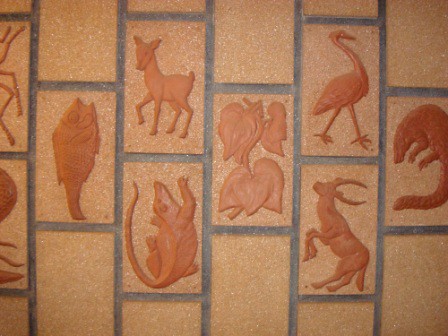
Animals symbolizing districts of Uganda
Its been a while since I wrote. Funny how when you stop writing, you also stop hearing from people. Bummer. Does that mean when I fall off the face of the planet, nobody will remember me? Even on my birthday in 2 weeks? Scary depressive thought.

Throughout this entire trip, I've been debating if the some of the crazy throughts are the effects of depression and dementia caused by malaria prophylaxis. Everyone says that Malarone shouldn't have any side effects but for an extremely drug sensitive person like me, anything will have an effect. Some of you even know that after 1 benadryl I can't even drive a car straight. I hate how drugs f*** with my body. Over the past two months, I notice that I get weird dreams and mild stomach cramps, depending on what time of day I take Malarone. It also seems to have more of an effect during different hormone cycles. I'm just really glad I'm not on Mefloquine, because people who are on that have experienced much more severe effects - hallucinatory, depression etc. The way I've been coping is to keep myself extremely busy, but since I've been traveling alone, and taking a break its been a little difficult.

I've mentally checked out since I left Moshi. A lot of the stress of traveling with another person and living with other people are gone, but I can't say if it's any better by yourself, especially because I've suddently become a bigger target for hassle.


Backlog to Kampala, Kigali -- I'll try and make this as short as possible.

KIST, Kigali, Rwanda
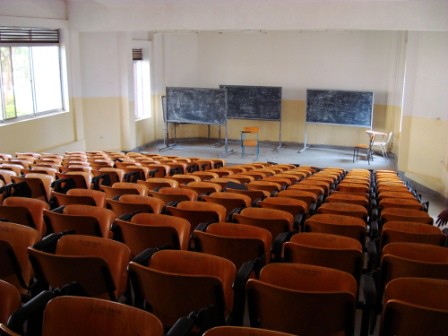
Chalkboards covered in partial differential equations at KIST

Kigali, Rwanda - Dec 27, 2008

The plane ride from Kilimanjaro to Kigali was ok, except the landing was a bit rough. Propeller planes and cross winds don’t do too well together. When we get to Kigali, everything is shut when we try to visit, even the genocide memorial. You know what is funny is that I am not here just to visit the memorial. I’m not a fan of miserable sites. I don’t like to come in with high expectations either, because that just creates disappointment. We are wandering the town and the university teaching hospital is there. We try to get a tour but can’t. There isn’t anything there until Monday, and I’m trying rudimentary French to get us by.

The fact of the matter though is that most people speak English. The only place where we heard French spoken widely was at the hospital. Everyone on the street, the stores, etc were speaking English. We are told the streets that we walk on are were the horrors happened. People’s bodies were strewn all over and dogs started eating them. They had to shoot all the dogs later because they had developed a taste for human flesh. Because the memorial was closed we went to Hotel des Milles Collins, where many refugees were hidden in the pool. Part of this hotel is being renovated, including the pool area. It has a 1960s architecture. Nothing mentioning the genocide. But everyone here is affected by it in someway. Even our bartender at the hotel who is the only surviving member of his family. I find the stories from the locals fascinating and telling of what happened here.


Kigali
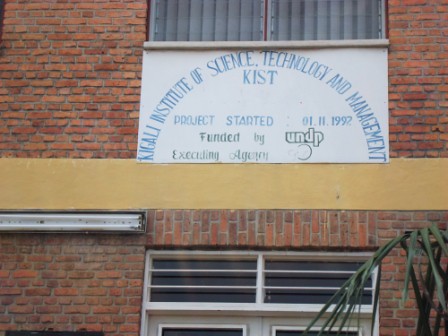
KIST's Original Old Building.


We stumble across KIST. I remember seeing this briefly in some lonely planet guide and we walk on in. The place is open, thankfully. KIST is the Kigali Institute of Science and Technology. I was curious to know where the current standards were. The first few buildings we saw were old and decrepit. There is sign above one that says the institute was funded by UNDP and was started in 1997. We wander around and pass by a cafeteria. Some of the students are still hanging out watching football in the cafeteria. A student follows us out and we say that we are just visiting, looking at the grounds. He is a 5th year civil engineering student here. As we walk further into the grounds the buildings change rapidly. There are giant, new buildings, that rival some of the largest research buildings I’ve seen at Stanford university, and in silicon valley. The newest building has not opened and was built by a Chinese construction company. The building was financed by the UNDP and the land was donated by the government. The land was previously military compounds and you can still see remants of buildings around the campus. Within the next few years, a new stadium will be built and another tract of land has been allocated for building dorms for students.

The new research buildling will be dedicated for research in the pure sciences: bio, chem, physics. Most of the labs here are closed; we only have a peek through the cracks of the doors. But what is most telling is what is being taught here. There are both science and engineering departments at KIST. The blackboards are covered with the last set of review material before exams a few weeks ago. Just looking at the math told me a lot. This is definitely NOT a toy technical school. They mean serious business. I see applications in multivariable calculus, partial differential equations, summations and statistics at a level I did not even study. They had a food science technology program, electrical engineering, civil engineering and more. Our student guide, Francis tells us that many of the professors are expats, from Russian, Bulgaria, America, India. They are given research opportunities in addition to teaching and many visiting professors also come to exchange ideas. KIST is Approaching World class. And I was impressed. Not even 10 years after the start, they are well on their way to moving Rwanda forward with this institution. They have multiple campuses spread out throughout Rwanda. This campus sits above the prime minister’s house and supports 2000 government sponsored students and about 3000 private students and night school students. To me, this paints a positive outlook for the country.

We go to this place called Heaven restaurant on the last night. The view is beautiful. From reading a bit about the restaurant it sounds like an american funded it and trains locals to deliver a restuarant/bar to NYC standards. While we're eating a chinese guy approaches me and starts chatting it up with me in Shanghainese! It is a little spoken dialect of chinese and I can't read or write it. About 7 million people only speak it worldwide, and its mostly concentrated near the city of Shanghai, China. He isn't the first one I met on the street that day; 3 others cornered me at a store to ask me where I'm from and other sorts of questions. They don't get to see many of their native people here in Rwanda. But most of them are from Chinese road, infrastructure and construction companies that are under contract to build for Rwanda. (I'm assuming something like the UNDP financed buildings at KIST).

Kampla, Uganda - through Dec 31, 2008

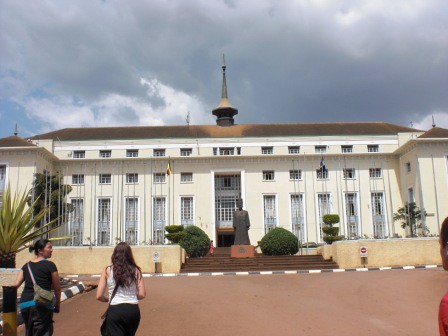
The Parliament, Kampala Uganda
The Ugandan Parliament

We get tickets for the bus to Kampala. It costs 8000 Ugsh for an 8 hr ride. That's about 16 USD. It leaves at 5:45 am, so we really have to scramble to get there on time. There is no announcement when the bus leaves. It just jerks and takes off whenever it feels like it. I have trouble remembering where my ticket is, and they come by and check it several times. Its really hard to dig for things in your bag with a cup of coffee and while the bus is swerving 180 degrees to 180 degrees every 20 seconds. Harrowing. Along the way we see a few accidents. The driving is madness. They bypass cars on curved roads.

When we first get on the bus, we run into a guy who is a money changer. He was in the back wearing a suit and so I thought he was the Kampala coach bus employee. So wrong was I. I hold out tanzanian shillingsand ask him to change it. I ask him for the rate, and then hand over some 200,000 TZSh and 10,000 RwFr. I get back about 190,000 Ugsh. Which is not good, but at 5:45 am, groggy, I know that it can't be that far off. She then hands him about 60,000 TZSh and says nothing, he hands her 32,000 Ush. Only 2 hrs later after a bone jarring swerving ride through the Rwandan mountains when we get out at the border I realize something is NOT right.

2 hrs later, we get out and form a line for the Rwandan exit border. You have to walk across the border to Uganda, and the bus waits for you on the other side. During the walk across I am hounded by Money Changers. I hear them yell out the exchange rate. I mention TZSh and one guy says I give you UgSH 1 to 1 for TZSh. SHIT. I start freaking out. I didn't think of it this morning but now it registers that Ugandan is 1700, and Tanzanian is 1300 to 1 USD. That means I got SCREWED. How much I don't know and I am groggy as all hell. The guys hound me. One has a calculator. I trying to do math in my head and think about if i did get screwed or not. I look in my pocket and there is only about 28000 USH. Did the guy actually give me only 10% of what I am supposed ot have?? Panic starts to set in. We are yelled at by the Bus staff to move it and get our visa at the Ugandan border. They are yelling at us. I am yelling back still stupidly thinking that the money changer was one of the staff. I'm realizing now that it wasn't. The bus staff are angry we aren't moving. I get in line. Michelle is begging for money from me because she doesn't have enough cash for her visa. I can't think straight. The bus driver is yelling at me at the VISA booth and telling me to go. He looks like he is going to punch me. I forget my passport, but Michelle is right behind me. Thankfully the customs agent gives it to her and we get back in the bus.

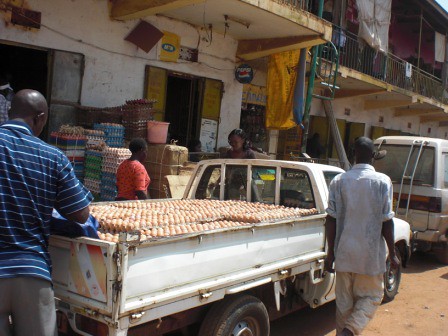
Kampala markets
Outside one of Kampala's Markets
Back in the bus, I count all of the money I have and I realize I am probably only short about 20 USD equivalent. But the exchange was not as bad as 50% exchange rate that Michelle got. As we cross the border, we get internet access on the iphones. There is no Edge internet in Rwanda. The landscape also changes dramatically. Rwanda has dozens of densely packed hills close together with very small valleys. Uganda is better farm land and you can see it change quickly. The hills are further apart and the valleys are ripe with irrigation and agriculture. The land is truly rich. It goes from hilly and spaced valleys to plains and rain forest all within a space of 6 hrs driving to Kampala.


 As we get closer to Kampala, more people board the bus. Michelle and I get split up and two natives sit between us. One of them is a parasitologist from Kampala. He gives me an informative tour of the country as we pass it. There is a lot of really rich land here but a lot of people don’t really want to do more than what they have to, according to him. It is sad, but he says it is part of the culture. And culture is hard to change in the people. We pass through several national parks on the drive. I have my own personal tour guide! He tells me about the problems with the Congo. The land there is exceptionally wealthy and he thinks that it will never be developed because everyone is always fighting over it. Kampala is full of slums on the edge. This is the dirtiest city I have seen yet here in East Africa. It is ridiculous. How much garbage and sewage there is here.


Kampala 054
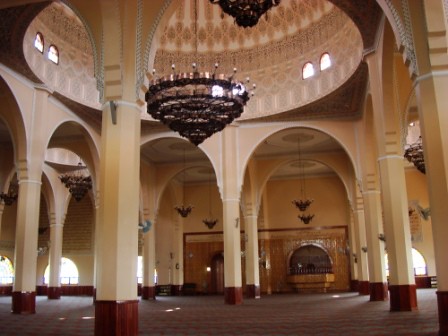
Mosque in Kampala, Uganda


We see bulls with giant horns that local to Uganda. And then lots of Mzungu cows. It similar in many ways to Tanzania, but also different in small ways. The land is really green lush and rich for the most part. Along the road, we even pass the equator; there is a giant ring to mark the spot. Along the way we see an overturned truck full of wood. The bus ride is not an easy one. Several times I felt like it was going to tip on its side. Lots of by passing but the driver also doesn’t seem to have much concern for the bumps. The speed that he went over several of the bumps sometimes threw us up out of our seats in the bus.

CIMG2280
Market in Kampala
Driving is crazy here in Uganda. It makes Tanzanian driving look nice. There are also motorbike taxis here like those in Rwanda. I brave my guts and actually get on the back of one these. They're called boda bodas. It costs about 2000 Ugsh to get to town from the 5-7 km where we are. Actually I'm terrified so I make a deal with the driver to pay him more if he drives safely. Some of the worst accidents happen on these bikes; there are women who ride them in skirts - sitting SIDEWAYS - on the bikes - extremely dangerous. The daladalas here all have a blue T marked on them. Unlike the ones in Tanzania, there is no sign for the destination, so its up to the money collector/caller to yell out the destination continuously; a very tiring job.

At the hostel, we meet a couple of German boys who are down from Yei, Sudan for the holidays. They just arrived and are looking to bargain a price for a city tour. The three of them are working for a German missionary in Sudan. Two of them are building houses and the third is working in accounting in the offices. Yes you heard that right they are on the Southern part of Sudan. We split a city tour of Kampala with them and visit the mosque, the parliament, a few markets and lake victoria - the source of the nile. The mosque we visit is huge.
Kampala, Uganda
Shopping in Kampala
What's interesting is this - Yei is on the southern border of sudan and is tightly protected by UN helicopters and other armed vehicles. The area of conflict is isolated to a part more east, but not very far away at all. In fact in the daily papers, there is a map of the conflict area and you can see that Yei is also on the map within a few hundred kilos or perhaps less. They have been living in Yei for more than 8 months and will stay for almost another year. From the pictures I've seen, a lot of the village looks like every other village in east africa. The same kind of mud huts, markets, the same kind of dress. More of the houses are grass thatch instead of corrugated metal. Even a sign says "Karibu" so we know that Swahili can extend that far north. As dangerous as the media makes of Sudan, it's not the whole country. And parts of it where these fellows work are tightly protected. The Southern part of Sudan is also experiencing a good amount of grown lately, people from Kenya and Uganda have been migrating over is masses to open more commerce there in the region.

Don't believe everything you read. hehe

Kampala, Uganda
Sitting inside the Ugandan Parliament

After a few days, Michelle is not feeling well and wants to fly to Kilimanjaro, so We don't make it to Nairobi. Durn. I would have like to see big bad Nairobi but maybe next time. We make a bee line for Moshi. On the flight, we are joined by the national Tanzanzian soccer team. Their head coach and assistant coach is importo from Brazil. Pretty cool. I have a neat chat with the old man and learn a few things. Their team is young. They are scrimmaging with other east african countries and recently with Sudan. One of the young fellows taps me so that he can borrow the newspaper I'm reading. This is typical of Tanzanians. Papers are for sharing, even with Mzungus. If you're holding it and not reading it, you'll get poked to share it. Same thing happened on the ferry to Zanzibar.

Thursday, December 25, 2008

Last week in Moshi, Arusha, Safari, and Kigali

WeeceTailoring01
Dec 19 was my last day in Moshi. This final week was really different from the first 3 weeks. At WEECE, Mama mrema came back in town and basically asked me to drop the schedule. I have yet to post case studies from Week 2 and 3, but I promise I will.

I help her write more letters and work in the office at the beginning of my final week. Her major project right now is getting a clinic in Nganjoni village built. Writing and editing for her is a challenge but I'm glad we're making progress. The Canadian Embassy has promised the project a grant but they need the approval of the district commisioner of Moshi. So we visit him at his office, along with TSF (terre sans frontiers), another NGO that is doing the project in conjuction with WEECE. He gives us his blessings, and then we move on to the Executive District Commissioner of Moshi, and Moshi Rural for a formal letter. When we walk into the office there, surprise! The Executive District Commisioner is a woman! The District comissioner says to me, you see, Gender Equity. We have, here in Moshi, heh heh. She is my boss. I get asked how long I've been here, how much swahili I know. I mumble a few words. Mama Mrema asks me when the hell am I going to really learn swahili? I say "Kesho" and she bursts out laughing. (Kesho means tomorrow, oh yeah, of course I'm terrible at learning new languages.)

On Wednesday, I'm join Mama Mrema for office work in the morning, then a visit to the Regional Commissioner of Kilimanjaro's office. This guy is a big honcho; he's almost like a governor and reports to the Prime Minister. The number of UN cars in the compound certainly shows. Our caravan moves to the Mkombozi vocational school where he is given a tour, to see what progress they have made. He is also invited to address graduation. I get a lucky chance to talk to him. When I say USA - He mentions that he has two children and he sent them to Tennessee to go to college. There is more than just a graduation ceremony; Mama Mrema is on the school board and gets to sit on the stage. Its a really long ceremony that goes on for 5 hrs!! It is scorching hot outside. I am about to die. Things are disorganized but organized. In the middle of the ceremony; people just wander about, speeches are going on simultaneously, followed by dance performances, the grads just wander around getting on their gowns. Little kids float. A truck backs its way into the ceremony between the stage and the grads and unloads furniture. Some guy rides his motorcycle partly into the ceremony then realizes halfway that something is actually going on? Um, that wouldn't happen in the US, would it?

My final two days I spent with Janine where we visit her placement with TAFCOM. I've been curious to know what is going on with this organization. What they do with the volunteers is bring them to homes with HIV/AIDS patients. They have projects where they try to provide assistance to low income families with HIV/AIDS. Of the two days, we visit about 3 homes each in the Pasua area of Moshi. This area is poor, rent for a 1 room house is about 5000-8000 TSH per month. Divide that by 1330 to get USD. Many people have no income or depend on their working children for income. Others are employed part of the year as coffee workers. Their immune systems are compromised so many cannot perform hard labor and nutrition is at a minimum. Many also do not have education beyond primary school. It's not clear to me how this organization is trying to accomplish assistance. They claim to have a plan to teach people skills so that they can sustain their daily needs and nutrition needs as HIV patients, but we weren't able to find or see a concrete proposal or budget for this. One of their plans is to teach local people mushroom growing as a source of income and nutrition. Mushroom growing is successful in Arusha and Mbeya, but if you look at the climate, both of these areas are lush, damp and green. To grow mushrooms successfully you need damp, humid dark soil consistently, unless you have the means to control for the environment artificially. This is a far stretch from Pasua. Pasua is extremely dry, hot, and while sometimes humid, the earth does not lie. It is barren. One hour north, toward Mt. Kili you have lush green, humid, tropical, and coffee trees grow there. But put a plot of land in Pasua and expect to get a mushroom project working within reasonable cost - I really question that. Large scale mushroom cultivation, as I know of it from the view of commercial purchaser is not simple, or straightforward in the USA. It takes skill. Small scale is different but if this is for income generation, it sounds like its going to generate terrible margins. Also we hear that many of the volunteers come here and give food and money to the families but it seems to defeat the purpose of the organization's goals because they want volunteers to adopt and sponsor families. We're not sure how this is really sustainable. It is also very difficult, to get straight answers out of the patients and the NGO workers. They do translate, but it can be hard for them to get answers because some issues are taboo and the means of asking is very roundabout - for example, I can't ask - what's the most pressing issue for her family right now?

I hate to sound like a cynic but this is my opinion and I only saw the people and organization briefly, so the skepticism may be unfounded.

I wish I could stay for another week. But sadly I have to leave because I am going on safari on Saturday. I leave Moshi friday afternoon and take a cab to Arusha. With the amount of luggage, I was told it would be safer to do this instead of dalla dalla. The house manager, Baba Fulgence asks me for a lift. No worries, I say.

On the way to Arusha, we can see many many houses that are half finished. I ask why. Unlike my asumptions, it's not because the people are too poor to finish them. There is a land grab - as the population grows, people want to buy land for their children so they have a place to settle. However, the government will take the land back if there is no house on the land. So people compensate by buildling half a house, and leaving it there until their children are ready to take it.

Unlike Moshi, Arusha is lush and green. You see more Mzungu cows. (cows that are like USA cows without the humps on their back). Baba says that the Mzungu cows are stupid and need hormones and lots of grass to prop them up or else they can't survive in this climate. They also need to be tied to the trees by the road because they are so stupid they don't know how to get out of the way when the cars come charging at them. The native cows here are skinny and have humps to store fat - fuel for a drought. They can also walk long distances without food; bottom line, they're adaptable to the harsh climate.

I meet Michelle in Arusha for our safari. She will be volunteering with CCS in January and we are traveling the next two weeks before her placement starts.

We do the tourist thing 4 days in Ngorongoro, Lake Manyara and the Serengeti. The animals were great. We even saw a cheetah eating lunch. I think what shocked me most was the ecology and how fast it changed from region to region. Hot, cold, dry, damp, moist all within a space of an hours drive. Oh, and we were visited by water buffalo outside our tents in the middle of the night chomping away at the grass. So Loud. Gosh the chewing was louder than their hoofs.

I don't like to plan things to the minute; especially here in a place where nothing is guaranteed to run on time. So the basic plan is to visit Rwanda, Uganda and back to Moshi in a circle. Originally I was going to take a peek at Nairobi, but I don't think we will have time.

I'm writing this post from Kigali on Christmas Day.

Yes, that's Rwanda, you read that right. No, its not scary. My travel partner, Michelle and I will be visiting the Genocide Memorials in a day or so.

Internet here in Kigali is really expensive, at 8USD/hr - actually everything in Kigali is much pricier than Tanzania. The exchange rate is about 535 KFranc to 1 USD. The actual prices are comparable to US prices for goods and services.

Rwanda is land of a thousand hills. And from the air, it is really clear. It's rolling hills up and down. We took a 2 hr flight from Kilimanjaro airport to get here in a propeller plane. The airport is really tiny in Kili, but. I had a knife in my carry on and already checked in my bags but they still let me go back and put my knife into my checked luggage.

Boarding is off the tarmac, which is really cool. I feel like we went back in time or something to the 1940s. The ride was bumpy due to the crosswinds but we made it safely there. Unlike what all the travel advisories say, there is no entry visa or payment for US citizens entering Kigali.

People here actually speak English fluently unlike what we expected. We were ready to start speaking french, if needed. Quality of streets here are a lot better, but I cannot compare with Tanzania because this is the capital city of Rwanda. I haven't been to Dar es Salaam yet.

Till next time, Happy Christmas.

Thursday, December 18, 2008

Infrastructure, Germs and Steel: Moshi and Vicinity

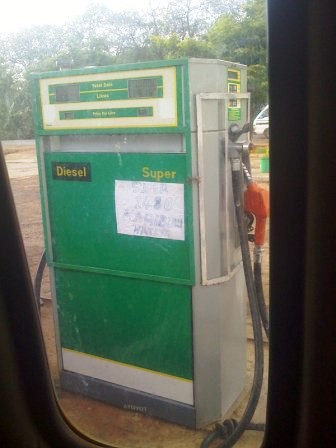
Petrol02
This entry is just a mishmash of observations from Moshi from the last couple of weeks.

Restaurants: they usually have a sink located in the corner of most sit down eateries for you to wash your hands. Right before you eat. The really good food here is Indian, Italian, Mediterranean fusion, Chinese food. Most of these owners are asian, indian, arab. Especially the bigger joints, you don't see owners that are native. The merchants are all expats. The panda chinese restaurant is run by a chinese family from Sichuan, China. It was nice to see some of my own people, finally after 2 weeks here. Sichuan is where they had that horribly large earthquake in China this past year. I ask one of the girls what she thinks of living in Tanzania. She says it's half - half. There are advantages and disadvantages to living here, but china can be equally bad. The competition is less here in east africa, because they are ahead, but they also miss being in their own country even the business here is good.

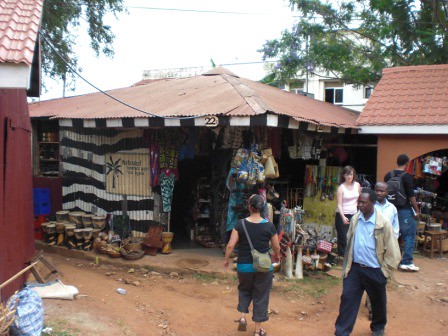
Internet: There are least 10 competing internet cafes or internet holes in downtown moshi. Whatever you do, avoid the one at the kindoroko. there are tons of viruses. best ones are the one next to The Coffee Shop and Chez Deli and behind the Kindoroko near buffalo.Best deal is the place next to the Coffee Shop (not lounge). It is run by an Indian guy 3rd generation here in Moshi. The place is air conditioned, has plenty of space and the equipment is decent. For every half hour you buy he actually tacks on an additional 9-10 minutes for service. cost is 1500 TSH per hour. The guy speaks perfect english, educated in the USA. The Place near buffalo is called Malaika Internet. Cost per hour is 1000 TSH and the keyboards are a bit sticky but otherwise ok. I tend to write everything in text pad and then copy paste to save time. Lots of computers have viruses, so be on the lookout if you are going to use your USB flash drive. I was able to get it cleaned at Malaika and at the Indian guy's internet.

Chagga/Masai tradition: We learn from Oscar on coffee tours that the Chagga give the youngest born son all the family land inheritance. The youngest will live the longest and should continue it, instead of the oldest. The Chagga live on the hills, closer to the mountains. The masai live on the plains, herding a lot of cattle, wearing really colorful red, blue draped clothes. I did not get a chance to visit a masai village but they wander all over town I saw plenty.

Dalla Dallas: I've gotten a lot braver taking these. I'm taking them every day. In town, the stops can sometimes be comical. The thing chuggs along for 200 meters and then stops. On the highway though, it can be scary. As long as you don't look out the front you're ok.
Advertising: Bulletin boards are a bit misleading, some are posted in the city centre near the roundabout, but the businesses are really far away. A lot of signs are shared with a coca cola ad. The top half is coke and the bottom half the name of a school, for example.

Shops on Mawenzi street: Mawenzi is the main 2 lane street in Moshi. Lots of the shops are own by multigeneration families from India, and Arabs. Many of them of proud of their Tanzanian citizenship; they don't consider themselves citizens of India. I don't know the details about history, but something bad happened about 70-80 years ago that created this immigration to east africa.

Road to Marangu: CCS took the entire house of volunteers out to Marangu for a day trip. Even though my feet were massively swollen, I still went. Didn't hike to the waterfalls but went along. Marangu is the last village stop to the "coca cola route" for those crazy people who want to climb Mt. Kilimanjaro. Ok, just crazy in my mind. I'm not a climber. The last mile to Marangu is off the main arusha highway and is all dirt. Houses along this road are marked with an X to indicate demolition but that won't happen until next year. That's how fast things move here. The market here is amazingly colorful, busy.

Store Supplies & Equipment: A lot of imports from South Africa, Middle East and Asia. Even wine is imported from South Africa. Lots of prepackaged goods are from the Middle east, especially Dubai. Other stuff is imported from mostly China, Japan. A lot of people here seem to know about Shanghai, China - my people! Many of the bikes are imported from Shanghai. They even know how to say hello in Mandarin, although unfortunately I can't speak it.
Power: Electricity can be sporadic. Most Electical is supplied by South Africa to most countries in East Africa and paid by tax payers in South Africa. How weird. How would americans feel, if they had to pay for all of Mexico's electrial needs?

Tuesday, December 16, 2008

Change of Guard & Some truth behind volunteering (CCS)

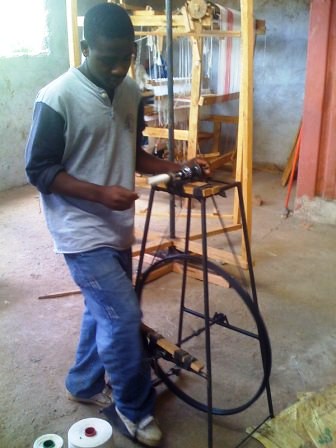
Weaving02
So most of the volunteers from the last group left the house this weekend. We got fresh blood on Saturday. The vocational school closed for the holidays last week. Instead of going away for another day trip this weekend, I decided to stay low key and spend a little extra time tutoring Peter's son. The kid has potential, especially if he is interested in IT here in East Africa. We worked on binary numbers and some basic math drills.

I like town. I like meeting random new people. I end up having dinner with Dricia, her colleague and a Kili climber. It was good conversation far away from the house and I stayed out in Moshi town, late into the night.

I like the new group of volunteers a lot. I am definitely a lot more comfortable with this group, and I think its because they are a really proactive, high energy group. They want to do something. They're not here to "pretend" to volunteer time as a PR stunt. Most of them are pretty mentally tough, open minded and have a positive outlook. Plus I am finally not the only non white volunteer in the house. And Andy is not the only guy in the house. There are 3 new guys in this group. I also really like having 3 asian/indian sisters in the house. Not only do I feel more comfortable reaching out, but everyone is also looking at the 4 of us in the house for guidance.

One of the things I learned today at placement was that there are a lot of volunteers that come here without having any expectations or truly understand the challenges behind volunteer work. It's certainly not glorious, and it can be ugly and difficult. A lot of NGOs can get disillusioned because they get volunteers essentially dumped off at their organization who really expect things to be handed to them. It doesn't work this way. Local NGOs are really looking to the volunteers for initiative if there isn't any structure in place. They also may be extremely jaded because they have seen lots of people come and go, and a lot of people aren't really reliable; in fact many of them come here to have fun, and aren't really committed to contributing or trying to make a difference. Some may have the desire to make a difference but they don't have the skills or tools to do that. Others can but they face the jaded attitudes from the NGO leaders or workers that they really aren't sincere and it takes a lot of effort to prove to them that they are really here to do something effective. I think often they give up on what people can do effectively and they resort to asking for money. Or if it is indeed something they can do, they want hard evidence that something is going to work before they're willing to trust you.

Bottom line, my advice is that if you are here for only 3 weeks, you may not be taken seriously, especially if your main goal here is to squeeze in as much fun as you want. I heard that one NGO basically refused to accept a CCS volunteer when they heard that she would be here for only 3 weeks. Their impression is that that the person isn't serious about committing to their cause. Which is sad, because how many people can afford more time than 3 weeks away? The cost of everything is really high these days.

The truth of the matter is that CCS packs in a tremendous number of activities in 3 weeks and makes it almost impossible to work at your placement full time.I was really frustrated with this. I would have liked to make more of these activities optional and drop them so that I could actually do real work. Although it wasn't much time I still feel like I have contributed a significant chunk in under 16 days. I'm ready to say I'm going to leave with more than I had initially expected to accomplish, but it also required me to haul ass and spend almost all of my free time alone and often away from all the social activities up until this week. I really wanted to spend a full day every day working at my placement; I ended up spending some additional time on weekends and some afternoons working on my placement independently so that I could be effective while I was there in the mornings.

I am behind on writing my case studies, but once I get out of here I will be sure to post them and follow up with everything else.

Hakuna Matata (no worries).