 |
| Animals symbolizing districts of Uganda |
Its been a while since I wrote. Funny how when you stop writing, you also stop hearing from people. Bummer. Does that mean when I fall off the face of the planet, nobody will remember me? Even on my birthday in 2 weeks? Scary depressive thought.
Throughout this entire trip, I've been debating if the some of the crazy throughts are the effects of depression and dementia caused by malaria prophylaxis. Everyone says that Malarone shouldn't have any side effects but for an extremely drug sensitive person like me, anything will have an effect. Some of you even know that after 1 benadryl I can't even drive a car straight. I hate how drugs f*** with my body. Over the past two months, I notice that I get weird dreams and mild stomach cramps, depending on what time of day I take Malarone. It also seems to have more of an effect during different hormone cycles. I'm just really glad I'm not on Mefloquine, because people who are on that have experienced much more severe effects - hallucinatory, depression etc. The way I've been coping is to keep myself extremely busy, but since I've been traveling alone, and taking a break its been a little difficult.
I've mentally checked out since I left Moshi. A lot of the stress of traveling with another person and living with other people are gone, but I can't say if it's any better by yourself, especially because I've suddently become a bigger target for hassle.
Backlog to Kampala, Kigali -- I'll try and make this as short as possible.
Kigali, Rwanda - Dec 27, 2008
The plane ride from Kilimanjaro to Kigali was ok, except the landing was a bit rough. Propeller planes and cross winds don’t do too well together. When we get to Kigali, everything is shut when we try to visit, even the genocide memorial. You know what is funny is that I am not here just to visit the memorial. I’m not a fan of miserable sites. I don’t like to come in with high expectations either, because that just creates disappointment. We are wandering the town and the university teaching hospital is there. We try to get a tour but can’t. There isn’t anything there until Monday, and I’m trying rudimentary French to get us by.
The fact of the matter though is that most people speak English. The only place where we heard French spoken widely was at the hospital. Everyone on the street, the stores, etc were speaking English. We are told the streets that we walk on are were the horrors happened. People’s bodies were strewn all over and dogs started eating them. They had to shoot all the dogs later because they had developed a taste for human flesh. Because the memorial was closed we went to Hotel des Milles Collins, where many refugees were hidden in the pool. Part of this hotel is being renovated, including the pool area. It has a 1960s architecture. Nothing mentioning the genocide. But everyone here is affected by it in someway. Even our bartender at the hotel who is the only surviving member of his family. I find the stories from the locals fascinating and telling of what happened here.
We stumble across KIST. I remember seeing this briefly in some lonely planet guide and we walk on in. The place is open, thankfully. KIST is the Kigali Institute of Science and Technology. I was curious to know where the current standards were. The first few buildings we saw were old and decrepit. There is sign above one that says the institute was funded by UNDP and was started in 1997. We wander around and pass by a cafeteria. Some of the students are still hanging out watching football in the cafeteria. A student follows us out and we say that we are just visiting, looking at the grounds. He is a 5th year civil engineering student here. As we walk further into the grounds the buildings change rapidly. There are giant, new buildings, that rival some of the largest research buildings I’ve seen at Stanford university, and in silicon valley. The newest building has not opened and was built by a Chinese construction company. The building was financed by the UNDP and the land was donated by the government. The land was previously military compounds and you can still see remants of buildings around the campus. Within the next few years, a new stadium will be built and another tract of land has been allocated for building dorms for students.
The new research buildling will be dedicated for research in the pure sciences: bio, chem, physics. Most of the labs here are closed; we only have a peek through the cracks of the doors. But what is most telling is what is being taught here. There are both science and engineering departments at KIST. The blackboards are covered with the last set of review material before exams a few weeks ago. Just looking at the math told me a lot. This is definitely NOT a toy technical school. They mean serious business. I see applications in multivariable calculus, partial differential equations, summations and statistics at a level I did not even study. They had a food science technology program, electrical engineering, civil engineering and more. Our student guide, Francis tells us that many of the professors are expats, from Russian, Bulgaria, America, India. They are given research opportunities in addition to teaching and many visiting professors also come to exchange ideas. KIST is Approaching World class. And I was impressed. Not even 10 years after the start, they are well on their way to moving Rwanda forward with this institution. They have multiple campuses spread out throughout Rwanda. This campus sits above the prime minister’s house and supports 2000 government sponsored students and about 3000 private students and night school students. To me, this paints a positive outlook for the country.
We go to this place called Heaven restaurant on the last night. The view is beautiful. From reading a bit about the restaurant it sounds like an american funded it and trains locals to deliver a restuarant/bar to NYC standards. While we're eating a chinese guy approaches me and starts chatting it up with me in Shanghainese! It is a little spoken dialect of chinese and I can't read or write it. About 7 million people only speak it worldwide, and its mostly concentrated near the city of Shanghai, China. He isn't the first one I met on the street that day; 3 others cornered me at a store to ask me where I'm from and other sorts of questions. They don't get to see many of their native people here in Rwanda. But most of them are from Chinese road, infrastructure and construction companies that are under contract to build for Rwanda. (I'm assuming something like the UNDP financed buildings at KIST).
Kampla, Uganda - through Dec 31, 2008
We get tickets for the bus to Kampala. It costs 8000 Ugsh for an 8 hr ride. That's about 16 USD. It leaves at 5:45 am, so we really have to scramble to get there on time. There is no announcement when the bus leaves. It just jerks and takes off whenever it feels like it. I have trouble remembering where my ticket is, and they come by and check it several times. Its really hard to dig for things in your bag with a cup of coffee and while the bus is swerving 180 degrees to 180 degrees every 20 seconds. Harrowing. Along the way we see a few accidents. The driving is madness. They bypass cars on curved roads.
When we first get on the bus, we run into a guy who is a money changer. He was in the back wearing a suit and so I thought he was the Kampala coach bus employee. So wrong was I. I hold out tanzanian shillingsand ask him to change it. I ask him for the rate, and then hand over some 200,000 TZSh and 10,000 RwFr. I get back about 190,000 Ugsh. Which is not good, but at 5:45 am, groggy, I know that it can't be that far off. She then hands him about 60,000 TZSh and says nothing, he hands her 32,000 Ush. Only 2 hrs later after a bone jarring swerving ride through the Rwandan mountains when we get out at the border I realize something is NOT right.
2 hrs later, we get out and form a line for the Rwandan exit border. You have to walk across the border to Uganda, and the bus waits for you on the other side. During the walk across I am hounded by Money Changers. I hear them yell out the exchange rate. I mention TZSh and one guy says I give you UgSH 1 to 1 for TZSh. SHIT. I start freaking out. I didn't think of it this morning but now it registers that Ugandan is 1700, and Tanzanian is 1300 to 1 USD. That means I got SCREWED. How much I don't know and I am groggy as all hell. The guys hound me. One has a calculator. I trying to do math in my head and think about if i did get screwed or not. I look in my pocket and there is only about 28000 USH. Did the guy actually give me only 10% of what I am supposed ot have?? Panic starts to set in. We are yelled at by the Bus staff to move it and get our visa at the Ugandan border. They are yelling at us. I am yelling back still stupidly thinking that the money changer was one of the staff. I'm realizing now that it wasn't. The bus staff are angry we aren't moving. I get in line. Michelle is begging for money from me because she doesn't have enough cash for her visa. I can't think straight. The bus driver is yelling at me at the VISA booth and telling me to go. He looks like he is going to punch me. I forget my passport, but Michelle is right behind me. Thankfully the customs agent gives it to her and we get back in the bus.
Back in the bus, I count all of the money I have and I realize I am probably only short about 20 USD equivalent. But the exchange was not as bad as 50% exchange rate that Michelle got. As we cross the border, we get internet access on the iphones. There is no Edge internet in Rwanda. The landscape also changes dramatically. Rwanda has dozens of densely packed hills close together with very small valleys. Uganda is better farm land and you can see it change quickly. The hills are further apart and the valleys are ripe with irrigation and agriculture. The land is truly rich. It goes from hilly and spaced valleys to plains and rain forest all within a space of 6 hrs driving to Kampala.
As we get closer to Kampala, more people board the bus. Michelle and I get split up and two natives sit between us. One of them is a parasitologist from Kampala. He gives me an informative tour of the country as we pass it. There is a lot of really rich land here but a lot of people don’t really want to do more than what they have to, according to him. It is sad, but he says it is part of the culture. And culture is hard to change in the people. We pass through several national parks on the drive. I have my own personal tour guide! He tells me about the problems with the Congo. The land there is exceptionally wealthy and he thinks that it will never be developed because everyone is always fighting over it. Kampala is full of slums on the edge. This is the dirtiest city I have seen yet here in East Africa. It is ridiculous. How much garbage and sewage there is here.
We see bulls with giant horns that local to Uganda. And then lots of Mzungu cows. It similar in many ways to Tanzania, but also different in small ways. The land is really green lush and rich for the most part. Along the road, we even pass the equator; there is a giant ring to mark the spot. Along the way we see an overturned truck full of wood. The bus ride is not an easy one. Several times I felt like it was going to tip on its side. Lots of by passing but the driver also doesn’t seem to have much concern for the bumps. The speed that he went over several of the bumps sometimes threw us up out of our seats in the bus.
Driving is crazy here in Uganda. It makes Tanzanian driving look nice. There are also motorbike taxis here like those in Rwanda. I brave my guts and actually get on the back of one these. They're called boda bodas. It costs about 2000 Ugsh to get to town from the 5-7 km where we are. Actually I'm terrified so I make a deal with the driver to pay him more if he drives safely. Some of the worst accidents happen on these bikes; there are women who ride them in skirts - sitting SIDEWAYS - on the bikes - extremely dangerous. The daladalas here all have a blue T marked on them. Unlike the ones in Tanzania, there is no sign for the destination, so its up to the money collector/caller to yell out the destination continuously; a very tiring job.
At the hostel, we meet a couple of German boys who are down from Yei, Sudan for the holidays. They just arrived and are looking to bargain a price for a city tour. The three of them are working for a German missionary in Sudan. Two of them are building houses and the third is working in accounting in the offices. Yes you heard that right they are on the Southern part of Sudan. We split a city tour of Kampala with them and visit the mosque, the parliament, a few markets and lake victoria - the source of the nile. The mosque we visit is huge.
What's interesting is this - Yei is on the southern border of sudan and is tightly protected by UN helicopters and other armed vehicles. The area of conflict is isolated to a part more east, but not very far away at all. In fact in the daily papers, there is a map of the conflict area and you can see that Yei is also on the map within a few hundred kilos or perhaps less. They have been living in Yei for more than 8 months and will stay for almost another year. From the pictures I've seen, a lot of the village looks like every other village in east africa. The same kind of mud huts, markets, the same kind of dress. More of the houses are grass thatch instead of corrugated metal. Even a sign says "Karibu" so we know that Swahili can extend that far north. As dangerous as the media makes of Sudan, it's not the whole country. And parts of it where these fellows work are tightly protected. The Southern part of Sudan is also experiencing a good amount of grown lately, people from Kenya and Uganda have been migrating over is masses to open more commerce there in the region.
Don't believe everything you read. hehe
After a few days, Michelle is not feeling well and wants to fly to Kilimanjaro, so We don't make it to Nairobi. Durn. I would have like to see big bad Nairobi but maybe next time. We make a bee line for Moshi. On the flight, we are joined by the national Tanzanzian soccer team. Their head coach and assistant coach is importo from Brazil. Pretty cool. I have a neat chat with the old man and learn a few things. Their team is young. They are scrimmaging with other east african countries and recently with Sudan. One of the young fellows taps me so that he can borrow the newspaper I'm reading. This is typical of Tanzanians. Papers are for sharing, even with Mzungus. If you're holding it and not reading it, you'll get poked to share it. Same thing happened on the ferry to Zanzibar.
Throughout this entire trip, I've been debating if the some of the crazy throughts are the effects of depression and dementia caused by malaria prophylaxis. Everyone says that Malarone shouldn't have any side effects but for an extremely drug sensitive person like me, anything will have an effect. Some of you even know that after 1 benadryl I can't even drive a car straight. I hate how drugs f*** with my body. Over the past two months, I notice that I get weird dreams and mild stomach cramps, depending on what time of day I take Malarone. It also seems to have more of an effect during different hormone cycles. I'm just really glad I'm not on Mefloquine, because people who are on that have experienced much more severe effects - hallucinatory, depression etc. The way I've been coping is to keep myself extremely busy, but since I've been traveling alone, and taking a break its been a little difficult.
I've mentally checked out since I left Moshi. A lot of the stress of traveling with another person and living with other people are gone, but I can't say if it's any better by yourself, especially because I've suddently become a bigger target for hassle.
Backlog to Kampala, Kigali -- I'll try and make this as short as possible.
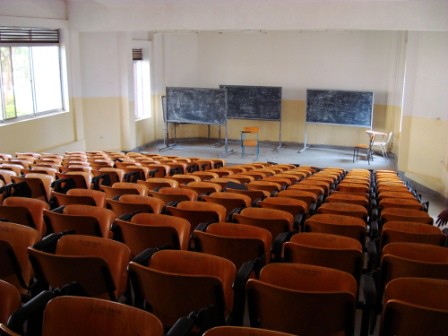 |
| Chalkboards covered in partial differential equations at KIST |
Kigali, Rwanda - Dec 27, 2008
The plane ride from Kilimanjaro to Kigali was ok, except the landing was a bit rough. Propeller planes and cross winds don’t do too well together. When we get to Kigali, everything is shut when we try to visit, even the genocide memorial. You know what is funny is that I am not here just to visit the memorial. I’m not a fan of miserable sites. I don’t like to come in with high expectations either, because that just creates disappointment. We are wandering the town and the university teaching hospital is there. We try to get a tour but can’t. There isn’t anything there until Monday, and I’m trying rudimentary French to get us by.
The fact of the matter though is that most people speak English. The only place where we heard French spoken widely was at the hospital. Everyone on the street, the stores, etc were speaking English. We are told the streets that we walk on are were the horrors happened. People’s bodies were strewn all over and dogs started eating them. They had to shoot all the dogs later because they had developed a taste for human flesh. Because the memorial was closed we went to Hotel des Milles Collins, where many refugees were hidden in the pool. Part of this hotel is being renovated, including the pool area. It has a 1960s architecture. Nothing mentioning the genocide. But everyone here is affected by it in someway. Even our bartender at the hotel who is the only surviving member of his family. I find the stories from the locals fascinating and telling of what happened here.
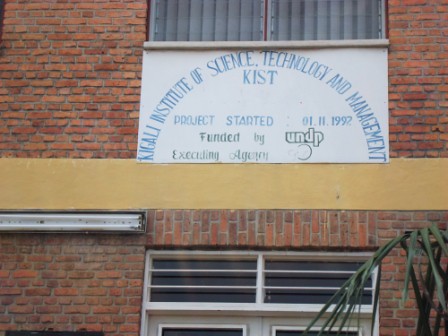 |
| KIST's Original Old Building. |
We stumble across KIST. I remember seeing this briefly in some lonely planet guide and we walk on in. The place is open, thankfully. KIST is the Kigali Institute of Science and Technology. I was curious to know where the current standards were. The first few buildings we saw were old and decrepit. There is sign above one that says the institute was funded by UNDP and was started in 1997. We wander around and pass by a cafeteria. Some of the students are still hanging out watching football in the cafeteria. A student follows us out and we say that we are just visiting, looking at the grounds. He is a 5th year civil engineering student here. As we walk further into the grounds the buildings change rapidly. There are giant, new buildings, that rival some of the largest research buildings I’ve seen at Stanford university, and in silicon valley. The newest building has not opened and was built by a Chinese construction company. The building was financed by the UNDP and the land was donated by the government. The land was previously military compounds and you can still see remants of buildings around the campus. Within the next few years, a new stadium will be built and another tract of land has been allocated for building dorms for students.
The new research buildling will be dedicated for research in the pure sciences: bio, chem, physics. Most of the labs here are closed; we only have a peek through the cracks of the doors. But what is most telling is what is being taught here. There are both science and engineering departments at KIST. The blackboards are covered with the last set of review material before exams a few weeks ago. Just looking at the math told me a lot. This is definitely NOT a toy technical school. They mean serious business. I see applications in multivariable calculus, partial differential equations, summations and statistics at a level I did not even study. They had a food science technology program, electrical engineering, civil engineering and more. Our student guide, Francis tells us that many of the professors are expats, from Russian, Bulgaria, America, India. They are given research opportunities in addition to teaching and many visiting professors also come to exchange ideas. KIST is Approaching World class. And I was impressed. Not even 10 years after the start, they are well on their way to moving Rwanda forward with this institution. They have multiple campuses spread out throughout Rwanda. This campus sits above the prime minister’s house and supports 2000 government sponsored students and about 3000 private students and night school students. To me, this paints a positive outlook for the country.
We go to this place called Heaven restaurant on the last night. The view is beautiful. From reading a bit about the restaurant it sounds like an american funded it and trains locals to deliver a restuarant/bar to NYC standards. While we're eating a chinese guy approaches me and starts chatting it up with me in Shanghainese! It is a little spoken dialect of chinese and I can't read or write it. About 7 million people only speak it worldwide, and its mostly concentrated near the city of Shanghai, China. He isn't the first one I met on the street that day; 3 others cornered me at a store to ask me where I'm from and other sorts of questions. They don't get to see many of their native people here in Rwanda. But most of them are from Chinese road, infrastructure and construction companies that are under contract to build for Rwanda. (I'm assuming something like the UNDP financed buildings at KIST).
Kampla, Uganda - through Dec 31, 2008
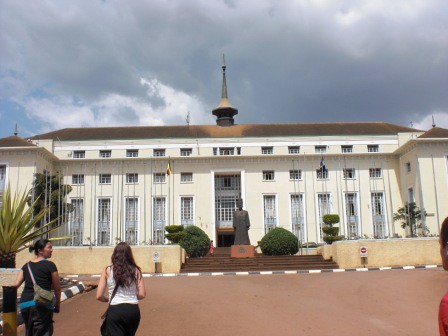 |
| The Ugandan Parliament |
We get tickets for the bus to Kampala. It costs 8000 Ugsh for an 8 hr ride. That's about 16 USD. It leaves at 5:45 am, so we really have to scramble to get there on time. There is no announcement when the bus leaves. It just jerks and takes off whenever it feels like it. I have trouble remembering where my ticket is, and they come by and check it several times. Its really hard to dig for things in your bag with a cup of coffee and while the bus is swerving 180 degrees to 180 degrees every 20 seconds. Harrowing. Along the way we see a few accidents. The driving is madness. They bypass cars on curved roads.
When we first get on the bus, we run into a guy who is a money changer. He was in the back wearing a suit and so I thought he was the Kampala coach bus employee. So wrong was I. I hold out tanzanian shillingsand ask him to change it. I ask him for the rate, and then hand over some 200,000 TZSh and 10,000 RwFr. I get back about 190,000 Ugsh. Which is not good, but at 5:45 am, groggy, I know that it can't be that far off. She then hands him about 60,000 TZSh and says nothing, he hands her 32,000 Ush. Only 2 hrs later after a bone jarring swerving ride through the Rwandan mountains when we get out at the border I realize something is NOT right.
2 hrs later, we get out and form a line for the Rwandan exit border. You have to walk across the border to Uganda, and the bus waits for you on the other side. During the walk across I am hounded by Money Changers. I hear them yell out the exchange rate. I mention TZSh and one guy says I give you UgSH 1 to 1 for TZSh. SHIT. I start freaking out. I didn't think of it this morning but now it registers that Ugandan is 1700, and Tanzanian is 1300 to 1 USD. That means I got SCREWED. How much I don't know and I am groggy as all hell. The guys hound me. One has a calculator. I trying to do math in my head and think about if i did get screwed or not. I look in my pocket and there is only about 28000 USH. Did the guy actually give me only 10% of what I am supposed ot have?? Panic starts to set in. We are yelled at by the Bus staff to move it and get our visa at the Ugandan border. They are yelling at us. I am yelling back still stupidly thinking that the money changer was one of the staff. I'm realizing now that it wasn't. The bus staff are angry we aren't moving. I get in line. Michelle is begging for money from me because she doesn't have enough cash for her visa. I can't think straight. The bus driver is yelling at me at the VISA booth and telling me to go. He looks like he is going to punch me. I forget my passport, but Michelle is right behind me. Thankfully the customs agent gives it to her and we get back in the bus.
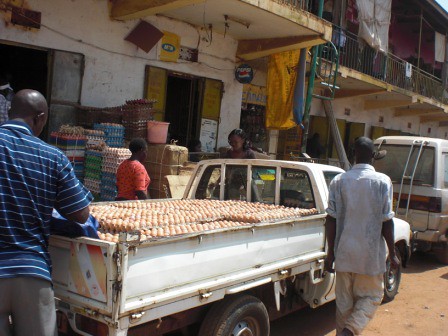 |
| Outside one of Kampala's Markets |
As we get closer to Kampala, more people board the bus. Michelle and I get split up and two natives sit between us. One of them is a parasitologist from Kampala. He gives me an informative tour of the country as we pass it. There is a lot of really rich land here but a lot of people don’t really want to do more than what they have to, according to him. It is sad, but he says it is part of the culture. And culture is hard to change in the people. We pass through several national parks on the drive. I have my own personal tour guide! He tells me about the problems with the Congo. The land there is exceptionally wealthy and he thinks that it will never be developed because everyone is always fighting over it. Kampala is full of slums on the edge. This is the dirtiest city I have seen yet here in East Africa. It is ridiculous. How much garbage and sewage there is here.
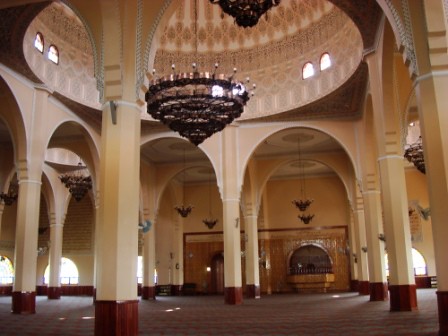 |
| Mosque in Kampala, Uganda |
We see bulls with giant horns that local to Uganda. And then lots of Mzungu cows. It similar in many ways to Tanzania, but also different in small ways. The land is really green lush and rich for the most part. Along the road, we even pass the equator; there is a giant ring to mark the spot. Along the way we see an overturned truck full of wood. The bus ride is not an easy one. Several times I felt like it was going to tip on its side. Lots of by passing but the driver also doesn’t seem to have much concern for the bumps. The speed that he went over several of the bumps sometimes threw us up out of our seats in the bus.
 |
| Market in Kampala |
At the hostel, we meet a couple of German boys who are down from Yei, Sudan for the holidays. They just arrived and are looking to bargain a price for a city tour. The three of them are working for a German missionary in Sudan. Two of them are building houses and the third is working in accounting in the offices. Yes you heard that right they are on the Southern part of Sudan. We split a city tour of Kampala with them and visit the mosque, the parliament, a few markets and lake victoria - the source of the nile. The mosque we visit is huge.
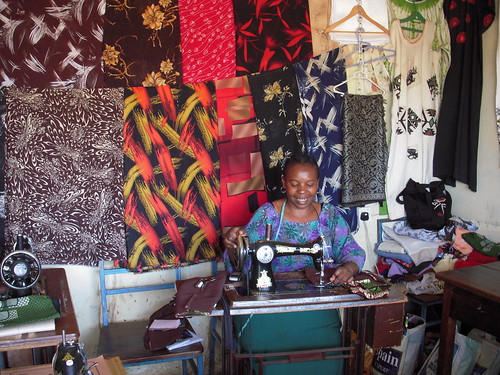
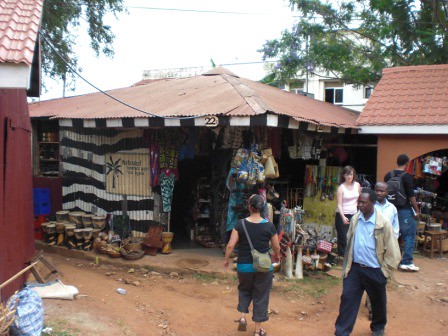 |
| Shopping in Kampala |
Don't believe everything you read. hehe
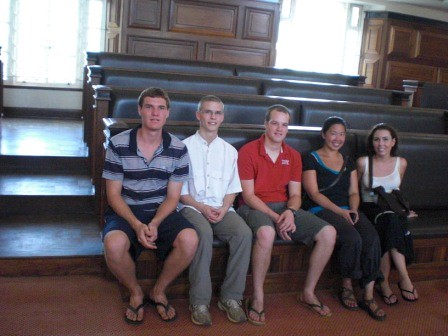 |
| Sitting inside the Ugandan Parliament |
After a few days, Michelle is not feeling well and wants to fly to Kilimanjaro, so We don't make it to Nairobi. Durn. I would have like to see big bad Nairobi but maybe next time. We make a bee line for Moshi. On the flight, we are joined by the national Tanzanzian soccer team. Their head coach and assistant coach is importo from Brazil. Pretty cool. I have a neat chat with the old man and learn a few things. Their team is young. They are scrimmaging with other east african countries and recently with Sudan. One of the young fellows taps me so that he can borrow the newspaper I'm reading. This is typical of Tanzanians. Papers are for sharing, even with Mzungus. If you're holding it and not reading it, you'll get poked to share it. Same thing happened on the ferry to Zanzibar.