Showing posts with label moshi. Show all posts

Wednesday, January 6, 2010

CCS Moshi : What to Pack, Safari, Climbing and Extra Curriculars.


CCS Moshi : What to Pack, Safari, Climbing and Extra Curriculars.

What to Bring:

Clothes: Weather is generally warm and humid. There are times when it will rain. The dirt roads will flood if that happens. Around Moshi, you will rarely need a warm jacket or long pants unless you are on the plane where it can get cold, or if you are going to climb Mt. Kili or Meru.

"Girls... bring either yoga pants (short ones) or stretchy shorts (spandex, bike shorts) or something like that to wear under your khangas here. You do not need to bring a tons of skirts as you can buy material here which is basically a khanga. You don't even have to get anything made as you can just wear it like sarongs. You will understand when you are here. Also your T-shirts get stretched out from washing them so bring tanks to put under"

"If you have extra room in your luggage and clothing at home that you dont need anymore, there are great places here to donate clothing. Most people leave a lot of clothes behind when they're packing (mostly because of all the things they bought here that they need room for)."


Shoes: I would defnitely bring one pair of good walking sandals, such as chacos or tevas. It would be a good idea if these are washable, as your feet will be filthy from walking on the dirt roads. If some of you want to go running in the mornings, be careful as there are lots of rocks and its very easy to sprain an ankle.


Snacks:


"Bring snacks you like such as chocolate, candy (enough to share if you want). "

There are now at least two supermarkets that will sell most snacks, although largely cadbury's and some south african chip brands, as well as ice cream. Coke products are prevalent throughout, however, in many places they don't let you take the glass bottle with you; you have to drink the coke and leave it at the location. Most 1st world luxuries are likely not available, but you may be surprised that you will likely find the equivalent of a 7/11 store, plus more. In addition, if you buy locally, you are contributing to the local economy in a good way.

Entertainment:

"If anyone has Ipod speakers those come in handy. Sometimes when we need a TV fix we all pile into one room and watch a DVD so if anyone wants to bring a few of those that would be great. Also, TV show seasons are a great thing to bring. " Some people bring their laptops so that they can watch their DVDs on them.

Money:

"In terms of money, I would recommend bringing bigger US bills, 50's and 100's, because they have a better exchange rate."

You can also get money from ATM's downtown anywhere

Medical:
"DEET bug spray is a good thing to have. Especially since with the short rains this season, its getting buggier. My bet is that you can find OFF bug spray in Target and other similar stores. There are different types of OFF with different levels of DEET."

There is also a ton of leftover bug spray from previous volunteers as well as hydrogen peroxide and other first aid in the bookshelf at CCS Karanga.

The most effective bug spray I found was from REI - the non-DEET kind. DEET oddly, is not as effective; I suspect that some of the mosquitoes have started to become resistant.

Safaris and Climbing

CCS is contracted to Bushmen Safari's. They do weekend safaris and also Mt. Kili/Mt. Meru climbs. For Safari's it is not possible to make a weekend trip to all 3 parks: Ngorogoro Crater, Lake Manyara and the serengeti. It is simply too far. You can do solely the Serengeti in a weekend. Or only Ngorogoro and Lake Manyara. If you want to do a safari that is longer than a weekend, please contact them directly. If camping is not your thing, be specific about your needs and request lodging or a lodging upgrade during your safari. Rains may occur during your safari and your tent may be flooded. Be sure to have some container to protect your electronics if you are bringing expensive kinds of electronics. (Personally I wouldn't bring anything precious or an heirloom when traveling but some people can't bear to part with their most precious belongings.....)

You can find information about them here: http://www.bushmenexpeditions.com/

If you choose to go with another safari company, it is wisest to make sure that they are TATO certified for safety standards and training. Driving in Tanzania can be exceptionally dangerous and it is your life that is on the line. The major trauma cases that end up in the hospitals here are Car Accident victims and Burn victims from cooking pots.


Getting to Zanzibar

Plane flights to Zanzibar may be canceled or consolidated at the last minute. Please DO NOT expect to be guaranteed a flight friday afternoon after your placement. Your flight may be consolidated with AM flights and then you will be forced to miss placement, which is really a disservice.

It takes about 1 full day's bus ride from Moshi to Dar es Salaam. From Dar es Salaam to Stone Town Zanzibar, it is either a 1.5 luxury fast ferry ride or a 3 hr standard ferry ride. There is some distance from the bus station to the Ferry, so you will need to take a taxi in between. If you leave in the early morning in Moshi - around 5 or 6 am, you may be able to catch the last ferry, otherwise you will have to overnight in Dar es Salaam.

Transportation to other parts of the island on Zanzibar may take anywhere between 1-2 hrs Taxi ride. Consider staying overnight in Stone Town before making your trip elsewhere around the island.


--------------------------------------------

The above quoted excepts by Talia Cohen, previous CCS volunteer at Karanga in Moshi. The rest are my comments with more information.

Thursday, December 3, 2009

How to Get Around Moshi, Tanzania


Here is what I send to all new Volunteers going to moshi:

Internet Map of Moshi : http://www.ismoshi.net/MapMoshi.htm


Taifa Rd: This is the major highway road that connects Moshi to Arusha and Dar Es Salaam. It is two lanes and is also the road that goes back to CCS Karanga. Karanga is several kilometers in the direction toward Arusha.

Best place for internet in town : two doors down from "The Cafe". Location marked by "S4" on the map. Mtaa wa KILMA rd between Market and Double Rd (also known as Mawenzi Rd) They don't have viruses on their computers. There is also a place that sells USB keys and other digital camera and electronic equipment - 1st world quality over on the street across from the mandela bank, on arusha and market street. (I think - my memory may be office but ask around and you'll find someone who knows) The owners are from Dubai.

Post office: is located near the Roundabout Circle, denoted as P.O. on the map and close to Kahawa house. Western Union is located across the street from the Post office. EMS courier post also available for shipping behind the Post office. Shipping packages to USA will cost about 50,000 TSH per pound air mail. Be sure to cover your packages entirely in brown paper or they will not accept.


WEECE volunteer placement:
 is on Sokoine Rd, north of Kilimanjaro Rd ... and is on the way to KCMC,. If you want to hitch a dala from Moshi town to WEECE, just ask for one going to KCMC - the major hospital in the area. From Weece to Moshi - you can get a dalad ala easily, just make sure they're going to moshi town - mawenzi bus station is THE major bus central station that gets you everywhere. Also where most of the taxis are. Kilimanjaro Rd, btw, is quite beautiful in winter, lined with their "christmas trees"


Kindoroko:
 This is the major hotel and shopping district, where all the tailors are located. There is a very good tailor at the corner near the kindoroko. Next door to the kindoroko is the Taj Mahal; the best local zanzibar pizza and BBQ at night time only. The owner is great and from Zanzibar originally. It is also a good place to be dropped off in town. It is located at the cross roads of Chagga Street and double street. There is a cafe on Chagga street but this is not "The CAFE" i was referring to above.

ATM/Foreign Exhange: Barclay's Bank ATM is located across the street from the Kindoroko. The best rates for Foreign Exchange is on Chagga Street, across from the Kindoroko.

Retail: Leather goods sold at Shah Leather goods. Also, several kilometers away from town toward Majengo on the Taifa, you can find great tailoring that beats the street tailors. Take a cab or dala dala. Great Business model. Forgot the name of the tailor but there is a sign in the shape of Africa outside.

Hotels: If you want to stay in town after CCS, I would recommend Bristol Cottages. Really nice, centrally located and amazingly quiet in town. Well managed.


Taxi/DalaDala :
 Taxis from Town to CCS Karanga should cost no more than 5000 TSH. Daladalas cost less and they will drop you off in front of the prison on Taifa road. then you need to walk down the dirt rd to CCS.

Corrections welcome.

All information effective as of January 2009. Updates are welcome!

Be sure to Print this out & Pass it on to other volunteers ............

Thursday, December 18, 2008

Infrastructure, Germs and Steel: Moshi and Vicinity

Petrol02
This entry is just a mishmash of observations from Moshi from the last couple of weeks.

Restaurants: they usually have a sink located in the corner of most sit down eateries for you to wash your hands. Right before you eat. The really good food here is Indian, Italian, Mediterranean fusion, Chinese food. Most of these owners are asian, indian, arab. Especially the bigger joints, you don't see owners that are native. The merchants are all expats. The panda chinese restaurant is run by a chinese family from Sichuan, China. It was nice to see some of my own people, finally after 2 weeks here. Sichuan is where they had that horribly large earthquake in China this past year. I ask one of the girls what she thinks of living in Tanzania. She says it's half - half. There are advantages and disadvantages to living here, but china can be equally bad. The competition is less here in east africa, because they are ahead, but they also miss being in their own country even the business here is good.

Internet: There are least 10 competing internet cafes or internet holes in downtown moshi. Whatever you do, avoid the one at the kindoroko. there are tons of viruses. best ones are the one next to The Coffee Shop and Chez Deli and behind the Kindoroko near buffalo.Best deal is the place next to the Coffee Shop (not lounge). It is run by an Indian guy 3rd generation here in Moshi. The place is air conditioned, has plenty of space and the equipment is decent. For every half hour you buy he actually tacks on an additional 9-10 minutes for service. cost is 1500 TSH per hour. The guy speaks perfect english, educated in the USA. The Place near buffalo is called Malaika Internet. Cost per hour is 1000 TSH and the keyboards are a bit sticky but otherwise ok. I tend to write everything in text pad and then copy paste to save time. Lots of computers have viruses, so be on the lookout if you are going to use your USB flash drive. I was able to get it cleaned at Malaika and at the Indian guy's internet.

Chagga/Masai tradition: We learn from Oscar on coffee tours that the Chagga give the youngest born son all the family land inheritance. The youngest will live the longest and should continue it, instead of the oldest. The Chagga live on the hills, closer to the mountains. The masai live on the plains, herding a lot of cattle, wearing really colorful red, blue draped clothes. I did not get a chance to visit a masai village but they wander all over town I saw plenty.

Dalla Dallas: I've gotten a lot braver taking these. I'm taking them every day. In town, the stops can sometimes be comical. The thing chuggs along for 200 meters and then stops. On the highway though, it can be scary. As long as you don't look out the front you're ok.
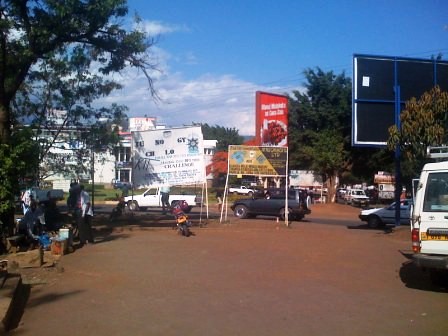
Advertising: Bulletin boards are a bit misleading, some are posted in the city centre near the roundabout, but the businesses are really far away. A lot of signs are shared with a coca cola ad. The top half is coke and the bottom half the name of a school, for example.

Shops on Mawenzi street: Mawenzi is the main 2 lane street in Moshi. Lots of the shops are own by multigeneration families from India, and Arabs. Many of them of proud of their Tanzanian citizenship; they don't consider themselves citizens of India. I don't know the details about history, but something bad happened about 70-80 years ago that created this immigration to east africa.

Road to Marangu: CCS took the entire house of volunteers out to Marangu for a day trip. Even though my feet were massively swollen, I still went. Didn't hike to the waterfalls but went along. Marangu is the last village stop to the "coca cola route" for those crazy people who want to climb Mt. Kilimanjaro. Ok, just crazy in my mind. I'm not a climber. The last mile to Marangu is off the main arusha highway and is all dirt. Houses along this road are marked with an X to indicate demolition but that won't happen until next year. That's how fast things move here. The market here is amazingly colorful, busy.

Store Supplies & Equipment: A lot of imports from South Africa, Middle East and Asia. Even wine is imported from South Africa. Lots of prepackaged goods are from the Middle east, especially Dubai. Other stuff is imported from mostly China, Japan. A lot of people here seem to know about Shanghai, China - my people! Many of the bikes are imported from Shanghai. They even know how to say hello in Mandarin, although unfortunately I can't speak it.
Power: Electricity can be sporadic. Most Electical is supplied by South Africa to most countries in East Africa and paid by tax payers in South Africa. How weird. How would americans feel, if they had to pay for all of Mexico's electrial needs?

Tuesday, December 16, 2008

Change of Guard & Some truth behind volunteering (CCS)

Weaving02
So most of the volunteers from the last group left the house this weekend. We got fresh blood on Saturday. The vocational school closed for the holidays last week. Instead of going away for another day trip this weekend, I decided to stay low key and spend a little extra time tutoring Peter's son. The kid has potential, especially if he is interested in IT here in East Africa. We worked on binary numbers and some basic math drills.

I like town. I like meeting random new people. I end up having dinner with Dricia, her colleague and a Kili climber. It was good conversation far away from the house and I stayed out in Moshi town, late into the night.

I like the new group of volunteers a lot. I am definitely a lot more comfortable with this group, and I think its because they are a really proactive, high energy group. They want to do something. They're not here to "pretend" to volunteer time as a PR stunt. Most of them are pretty mentally tough, open minded and have a positive outlook. Plus I am finally not the only non white volunteer in the house. And Andy is not the only guy in the house. There are 3 new guys in this group. I also really like having 3 asian/indian sisters in the house. Not only do I feel more comfortable reaching out, but everyone is also looking at the 4 of us in the house for guidance.

One of the things I learned today at placement was that there are a lot of volunteers that come here without having any expectations or truly understand the challenges behind volunteer work. It's certainly not glorious, and it can be ugly and difficult. A lot of NGOs can get disillusioned because they get volunteers essentially dumped off at their organization who really expect things to be handed to them. It doesn't work this way. Local NGOs are really looking to the volunteers for initiative if there isn't any structure in place. They also may be extremely jaded because they have seen lots of people come and go, and a lot of people aren't really reliable; in fact many of them come here to have fun, and aren't really committed to contributing or trying to make a difference. Some may have the desire to make a difference but they don't have the skills or tools to do that. Others can but they face the jaded attitudes from the NGO leaders or workers that they really aren't sincere and it takes a lot of effort to prove to them that they are really here to do something effective. I think often they give up on what people can do effectively and they resort to asking for money. Or if it is indeed something they can do, they want hard evidence that something is going to work before they're willing to trust you.

Bottom line, my advice is that if you are here for only 3 weeks, you may not be taken seriously, especially if your main goal here is to squeeze in as much fun as you want. I heard that one NGO basically refused to accept a CCS volunteer when they heard that she would be here for only 3 weeks. Their impression is that that the person isn't serious about committing to their cause. Which is sad, because how many people can afford more time than 3 weeks away? The cost of everything is really high these days.

The truth of the matter is that CCS packs in a tremendous number of activities in 3 weeks and makes it almost impossible to work at your placement full time.I was really frustrated with this. I would have liked to make more of these activities optional and drop them so that I could actually do real work. Although it wasn't much time I still feel like I have contributed a significant chunk in under 16 days. I'm ready to say I'm going to leave with more than I had initially expected to accomplish, but it also required me to haul ass and spend almost all of my free time alone and often away from all the social activities up until this week. I really wanted to spend a full day every day working at my placement; I ended up spending some additional time on weekends and some afternoons working on my placement independently so that I could be effective while I was there in the mornings.

I am behind on writing my case studies, but once I get out of here I will be sure to post them and follow up with everything else.

Hakuna Matata (no worries).

Monday, December 15, 2008

Week 2: Case Studies at the Ground Level (CCS)

Road02
On my Todo list this week:

1. Write case studies from wk 2 and wk 3 (1 visit due to holiday)

2. Template


This 2nd week is packed with visits.

Weece End Note

I really wish I could spend more time in Moshi. 4 weeks is hardly enough, especially with a ridiculously crammed activites during the first 3 weeks. If I had to do it again, I'd only want 1 to 1.5 weeks of planned activities, so that I could focus more on my placement. I know I have done a LOT of work, beyond what I've been asked for but only because I saw what direct impact it would make and I really wanted to do it. While I still feel like I'm not finished, but Most Importantly, I know I am leaving everything in a good space before I leave. Have lots of plans to continue this online when I return to the states.

More case studies need to be written; because I was dragged back into the office during week 3 and 4 I was able to complete all of my visits, so there are only about 7-8 case studies.

For future volunteers I have created a Interview Template for each business visit. I plan to leave several copies with WEECE and with CCS. It is my hope that the template will:

1) help future volunteers understand the business better by having a guideline to ask questions

2) send us the collected information by email so that we can work promote weece online

3) encourage volunteers to collect pictures of local businesses to pair with the stories.

Friday, December 12, 2008

Getting out of the House (CCS)

Moshi02
06 DEC 2008

Last weekend, I had to get out. Early in the morning, I packed a few clothes and hiked up to the main road - about 1km. Really I wanted to get some work done in town because it really is impossible at the house. I didn't bring a laptop on purpose, it just doesn't make sense if I plan on backpacking after.There is only 1 computer at the house and 15 people. It can get really antsy.

I take the Dalla Dalla to town. I've gotten a bit braver at riding it; plus its nice to get out fast - waiting for a cab and getting a herd of people to go with can take up to an hour. Plus, I started noticing that if I say Dalla Dalla, most people don't want to do it. They're too scared. Chickens.

I spend a lot of Saturday online. I picked the wrong place to do my work and it is so damn slow. I find out later I went to the wrong place but get my stuff done anyhow. Ran other errands; if i did this with anyone else they'd hate me by the end because I went to so many different places and didn't decide until the last minute which one I wanted to go to.

The power gets cut twice when I'm in town, so everytime that happens I take a break and walk around the block. There is an ice cream store and I pop my head in for some candy. Most foreigners here stick out like a sore thumb and everyone tends to chat with each other when they are just walking around. I also get to meet more people when I'm walking around by myself. Perhaps it's just me, but I hate being insular especially abroad. At the ice cream shop, I meet two Peace Corp workers.
MoshiIT02
The peace corp workers are hard core. They're out in remote villages for a commitment of 2 years by _themselves_. They seem really together mentally. I really admire the fact that they can deal with the hardship of living in really poor remote villages and be ok with being the only foreigner for long periods of time. I'm told that they come into town once a month for bank, internet, other goods and to meet other peace corp workers. Leiha is from Boston. She says it takes and average of 3 hrs, 1 hr of that by dirt road to reach each of their villages. Plus they are really nice people. I am so glad I got a chance to meet them; it's a completely different mindset from volunteers who are here for only a few weeks. And I really like it because it puts everything into perspective.

I meet another woman who is working on a massive linguistic project; to build a better swahili/english translation project online. Dricia is a South African that can talk for hours, but I'm glad to hear that I'm not the only person who thinks there are deep cultural issues at hand. Her project is forward thinking. I really like it and will be in touch with her.

By the time I'm done with all my errands, I have to pick a place for dinner. Next to the Kindoroko, the Taj Mahal has its grills out full force. The food is really good and cheap. For 1700 TSH ( or about 1.50?USD) I get a full meal. Two really amazingly good beef kabobs for 500 TSH each and a veggie/egg fried calzone for 700 TSH. lots of condiments, mint sauce. Delicious.

So glad I'm not going home to the base tonight. I crash at the backpackers hostel in moshi 1 block away. What a good deal - 8400 TSH for single. Too bad I didn't bring a towel.

07 DEC 2008
DSCN0132
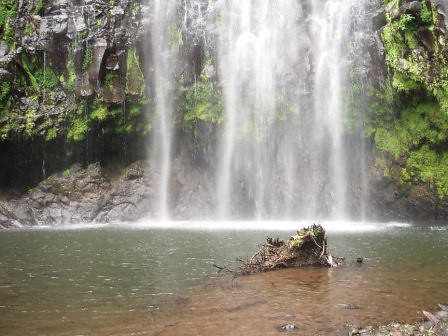
Sunday I went on a coffee tour with Bushmen Expeditions. It was only 4 of us from the house and it was nice to get away in a small group. It is a long 1 hr hike out to Mnambe falls. But it is amazingly beautiful. And I liked the exercise too. Hiking is a must do here. For a minute I felt like I was transported to Hawaii or some other tropical paradise.

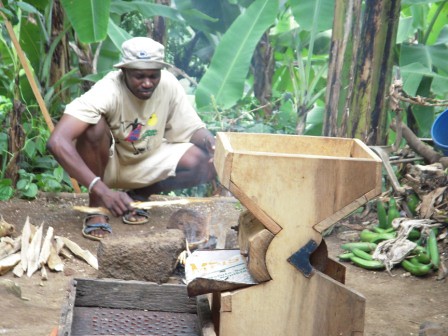
After the hike, we don't just learn about the process of making coffee, we actually make it ourselves! It was a lot of fun. Oscar is one our guides and we make coffee in his grandfather's village. It's african style but to me its' not authentic. If you look closely you can see the hints of modern technology and money. From a distance the huts look poor, but inside you see a great sound system, tv and they have cable and a big antenna outside. Nice concrete floors as well. The chickens are really fat and well fed.
DSCN0138
Totally different from the really sad chickens and dogs that are running around near our compound. I have never seen such sad pecked out chickens or dogs with every single rib showing, sick and underfed.

Independence Day & that famous safari city

DSCN0060
13 DEC 2008

This entry runs a bit backwards in time. But it was fun to tie it together.

Thursday afternoon after placement, we went to Arusha, that famous safari city where everyone begins their trip to the serengeti.

Arusha is a NICE town. Let me tell you, after 3 weeks in Moshi, it really is a luxury to see perfectly paved, sealed off streets without any cracks, dirt, or stones. That is Arusha. People say Arusha is dirty, polluted, congested. Yeah, but there is a lot less dirt when you don't have to drive through a dirt road. There are also no crazy chinese/japanese, mexican style graffiti, and heads of Che Guevara covering the dalla dallas here, tons of land rovers, 4x4s for all the safaris. It really is a money town. I count lots of banks. Bank on every corner. Rich town, man. Yes there are touts and people really harassing you to sell their wares, but by now after enough practice in moshi, you know how to talk back to them and deal with the haggling. Prices are ridiculous in Arusha. $30 for a shirt you could get in Moshi for $5 USD or less. They hawk the tourists. It's really messed up. It's as bad as it is at the Great Wall of China where market places are constantly harassing white visitors with their wares. I was so glad I blended in.

A lot of people complained that we couldn't see any trials at the Rwanda Tribunal for the 1994 genocide, but I didn't mind. It was a treat to come out here and see the small business exhibition and other places in town. They have a giant Shop Rite that is a supermarket on par with a decent sized supermarket in the USA. It is approaching 1st/2nd world quality. A bit thin on the magazine side, but I can't complain - especially when I discover that a copy of the economist here costs only 9800 TSH. On Monday a paper boy tried to sell it to me for 13,500 TSH in Moshi. I declined. There are only 2 major magazines that show up here: the economist and Time magazine. As for newspapers, you have a choice of the East African, Guardian.co.uk or Tanzanian national news. All are pretty decent.

Definitely no shortage of US news. Lots of us are getting dresses made by a street tailor near the Kindoroko Hotel in Moshi; we have to wear skirts to placement. Earlier this week, I was waiting for Kindoroko lady to finish my dress, so I sat and read the East African - A new US film about Che Guevara is out and was screened recently. Actor Benicio del Toro plays the revolutionary. Che is big here in Moshi. One out of 8-10 buses in downtown Moshi has Che's head plastered on the front corner of the bus, with a red and green stripe on the side. Why they do it I don't know? I will have to ask but it is not the same situation in Arusha. It is definitely a lot more ghetto here in Moshi. (Thanks to Santiago Ripley for wearing a t-shirt of Che; I wouldn't have otherwise known).

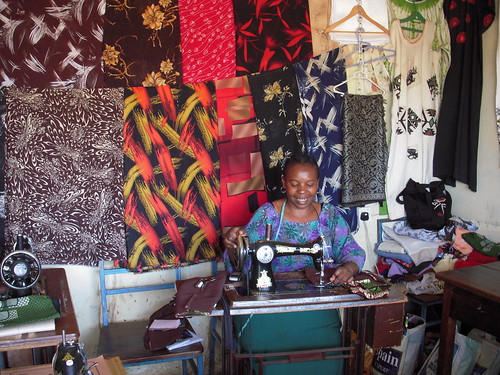
Independence day is on 09 Dec 2008. Most places are, of course closed or open until noon. But there are a few smart entrepreneurs who are still open for business, out of need or knowing that there is good biz. I'm supposed to be due back at the house at 1pm so that we can learn how batik is made; and I wait for Kindoroko lady to finish my skirt. I tell her I can come back thursday to pick it up, but she insists that she haul it out within the next hr. I say ok, then I tell her 10 minutes left.... 5 min left.... The woman is smart. She knows how to move fast and get the sales going. She also have 3 girls that are her assistants. While I'm waiting for her, I buy a bag as well. The ends are entirely sealed up past the zipper ends so I ask one of her girls to do that. I watch as she does an ok, but somewhat loose stitch, so I show her how to do a tigher stitch that will hold somewhat better with wear and tear. How is that for cultural exchange? I only learned about sewing just 6 months ago myself? =)

Kindoroko lady has another assistant cranking away at the iron and evening out the rest of the fabric for another customer. Most of the tailors here are on the street and they have a lot people that just drop in and socialize.

Some rasta guy walks on by and says "Pop it open, Dada*. I want a smoke".

The assistant rolls her eyes upwards, slightly annoyed. She pops the top of the iron open.

Rasta man sticks his ciggie into the iron and lights it up.

The irons here are all powered by *charcoal*! They don't use electric, even the sewing machines are manually driven - foot powered. Omw. Just had an "in africa" moment.

Rasta man takes a whiff and goes " Dada, you know today is Independence day. We all supposed to love another and relax and do no workie workie. "

Kindoroko lady looks in my direction, like she wants this crazy guy to leave and gives me a tight lipped grin " Okeee kaka... that's fine. sure sure."


* Dada is Swahili for sister. Kaka is brother

Sunday, December 7, 2008

Advice for New Volunteers (CCS)

DSCN0146
I realize most of you reading this blog are not coming here to volunteer, but if you are curious to know what challenges there are I want to share some Words of Wisdom (WoW).

1. Guilt Trip. For a lot of people, it's really hard to adjust because its really easy to feel bad, guilty about the poverty. I'm writing about this because I've heard a lot of complaining and angsting about this since I've been here. The MAIN THING to remember is that you are here to give people Intellectual Capital (IC) - to bring and share your knowledge and How To..... and not give handouts, free money, or candy. It is hard for a lot of people to say NO, but No is the right thing to do, because otherwise it is not sustainable and feeds the culture of "Gimmie, gimmie" and when the give aways are all used up, there is nothing left and they dont' want to work hard and change their lifestyle because "gimmie gimmie" is so easy. Some people feel that they have nothing to give but if you're from a first world country this is not true. Ask questions. Talk to people. Think. Don't complain. And most importantly, don't be guilted into thinking "oh if I can just save one, or if can just help one" - like the woman in the movie "The Constant Gardener"

Bottom line, Don't. It only serves to feed the wrong attitude and feeds the already vicious cycle that creates a failed state. Unlike physical goods or money, IC is limitless. George Bernard Shaw once said, "If you have an idea and I have an idea, and we trade ideas, then we each have 2 ideas. But if you have an apple and I have an apple, and we trade apples, we still only have 1 apple each. " If the problem is lack of money, then ask where is the money being used, where is it being spent, how is it generated in the first place. And then find ways to generate - key word here --- > sustainable income. Not donations.

2. Thick Skin. Bring a thick skin especially when you come into town - people keep asking for money and will try to talk to you on no end since we're not black. If your regular job involves saying "No" a lot of the time to people, then you have an advantage. My phone rings off the hook with people asking me to buy buy buy, and after a while, it's mean but sorry Christina's not here, i'm transferring you to voicemail. I don't have enough capital to give a grant to every single researcher out there, sorry.

3. Respect other people's space. I am having a bit of a challenge with the other volunteers in the house - I to think about the positive and not the negative. We all have a limit. I can't listen and socialize all the time. Most of all, it is very hard to listen to a lot of complaining when I'm really tired. I have a lot of patience but there is a limit. Especially when my placement is tiring, both physically and mentally. I tend to get quiet when i'm really tired and antisocial, but it doesn't mean i don't like you. I just need quiet time to think and also because I am tired. Some people don't get this and want to force socialization on you. Don't let them.

4. Learn Learn as much Swahili as you can. Talk to staff members and ask questions. They will give you the tools to understand and survive here. Ask a lot of questions. It will not only help you get around but also understand what is going on in the minds of local people and why things are they way they are here in Tanzania.

5. Give everything a lot of time. Give yourself plenty of alone time if you need it to process everything going on around you. Also, things move really slowly here; don't expect anything to get done on time. At ALL. or ever. The electricty is intermittent and can go out at any time. There is only one house computer and people can get really bitchy about how much time you spend on it. The only way I've gotten around it is to go to town and spend time there using the computers.

Above all, I want to emphasize that is the Idea that is powerful, not the goods.

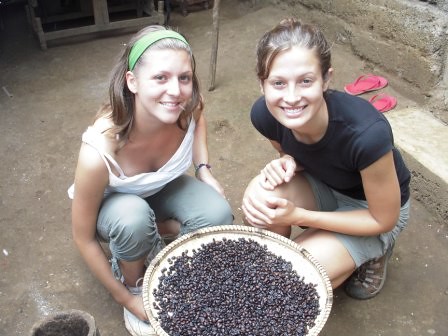
Okay, I will get off my soap box now.  Smile like these two volunteers!

Thanks for reading.


DSCN0140


Wednesday, November 26, 2008

Hello from Moshi

DSCN0116
November 24, 2008

It is Monday morning 6am as I write this. I’ve been here in a village several km from Moshi now for 2 days.

Backtracking….


The flight from Boston to Amsterdam was pretty awful. I was ready to puke when we landed; the turbulence was really bad. It was compounded by the snowstorm that peaked about an hour after arrival. On a more positive note, I did see something exciting at the newsstand before I left. I thought I was hallucinating but the cover of GQ magazine was definitely moving like those movable pictures from Harry Potter. Upon closer inspection, I discovered it was the first commercialization of E-Ink! How exciting. I’ve heard about it for years, but never saw it out on the street so I had assumed they were still years away from it being practical. It’s a bit thick – the cover feels like a flexible CD. The actual display is super thin, but I was somewhat disappointed by the thickness of the circuit board inside. It was really hard not to buy a copy and take it apart. I have to stay and pack light. Hopefully the board will also flex like the display soon? Okay I will shut up and stop being a technophile now.

Its been a really long time since I’ve been at Schipol Airport but honestly, I am somewhat disappointed by it. Virtually everything is in English. It is so Anglicized and Americanized. The guy who sells coffee to you speaks perfect English. You have to hunt to find the real Dutch, even on the signs it’s a bit obscured. It really feels a bit like walking into an Ikea. Okay I guess for American travelers and there a shitload of them. Even the KLM flight on the way down is chalk full of them and a bunch of annoying pushy French people. A lot of white people on the plane to Kilimanjaro. Not so many black people. Almost no asian people. Some middle easterners.

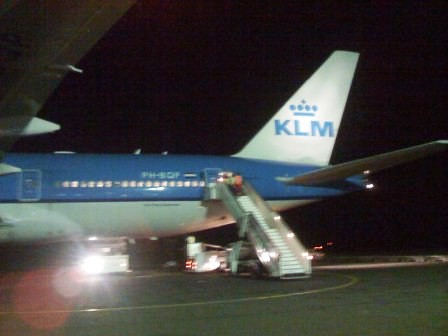
KiliAirport02 By the time we get to Kilimanjaro, it is pitch dark. And you can see nothing. KLM lets you disembark from the plane straight onto the ground like the good old days. It’s the only major aircraft that’s sitting on the runway. It is hot and humid. We get our luggage and the driver collects us into a van. It is really dark outside. The major road between Arusha and Moshi is this 2 lane road that’s not lit at all. It’s kind of like the main road to Gerlach, NV. No, nix that. This 2 lane road is the equivalent of 101 or I 95 in the usa. Stars everywhere outside at night. We drive past a row of trees and it smells incredible. Everyone’s asking what kind of tree, and we find out that its called a “Christmas tree”. There are a lot of these in town.

We’re taken to a really nice house. I mean, the house here is really nice. It’s off a dirt road, but completely westernized. It reminds me a bit of, south east asian architecture. There are actually 2 houses in this compound. We stay in the back. Cell service works here. And it’s really strong, with iPhone Edge access. Unlike what AT&T told me the internet is getting pushed here. I’m impressed. I don’t even get a cell signal in Gerlach, NV.

The first night is always really hard after any trip that takes you more than 8 time zones away. It usually takes me about 1-2 weeks to adjust when going to south east asia. Here we are 10 hrs ahead of Pacific Coast time in California. Even though I was on the east coast for a week cutting 3 hrs off doesn’t really make a dent. I feel wasted. But I can’t sleep. There are a ton of really loud animals here that come alive in the middle of the night. The dogs are out of control. They’re mostly wild dogs and are bone thin, scrawny with fleas. We learn later that the dogs are always at odds with the bush babies that come out at night.

The elder women here in Tanzania are called Mamas, whether they have kids or now. Our house Mama is called Mama Lilian. She gives us the scoop on how to behave here. And I’m about to fall asleep as she drones on about the rules and what we should expect. Half way through, oh the irony -- We’re told not to use drugs here. Or we’ll be booted from the premises immediately. And just as she says that, there’s a waft of sweet smelling pot that floats by. It’s smells sweet. Not like American stuff that’s rolling around and a bit bitter. We all really try hard to keep a straight face.

About half the house is full when we arrive. They are mostly younger volunteers between 18-25. Some students, other young people on a gap year. A lot of them are teaching at nursery schools or working with young kids in elementary schools. In Tanzania, it is required by law for all children to go to school through 7th grade. It is paid by the government, but the parents have to pay for the uniforms and some other small fee (I think). Sorry I don’t know if my facts are all straight because I was too tired to pay attention. There are a lot of information sessions the first couple of days. Thankfully there are only 5 new people to get to know. There are about 8 volunteers that are already here from the previous session; many of them are here for the maximum duration of 12 weeks.

We’re given a tour around Moshi town. We almost run over a tiny dog. It is SO loud. These tiny scrappy dogs. On our way to town some bus cuts ahead of us. The back of it is covered with Chinese characters. Apparently a lot of buses and older cars from Asia and Europe are just imported here and driven as is. People drive scary fast here and lots of people hang off the edge of daladalas and trucks.

The driver takes us away from the town because the kids want to visit an art market. They are set up in little stalls. The art is pretty good. We even see a bob marley flag. People certainly know how to do business here. We are told it is low tourist season, so expect more hassling and haggling. One of the volunteers here mentions that its really hard to say no to locals that hassle you repeatedly. After a while you just cave in and buy something.

Downtown there are lots of little stores. Most of the smaller vendors are on dirt floors. Higher end stores have concrete on the base. I figured correctly not to bring a lot with me; you can get a lot of goods here. In the supermarkets, a lot of the goods on the shelves are imported from the Europe, UAE, Doha, Japan, China, etc. What else do you expect? Not much US imported goods comparatively. There’s basically M&Ms and Coca cola.

I’m so exhausted by the end of the first full day here I even miss dinner. I sleep from 3pm until 6am the next morning. By the end of the first day ankles are super swollen. I am really terrified. I’m not sure it’s from a blood clot or from the airplane or whatever. My dad had the same thing happen before his quad bypass.

I have two roommates here. They are really nice. One is in her late 30s, Chandra, and was formerly a teacher. The other, Louisa is a former nurse and in her 60s. Everyone is pretty poa (cool). I’m actually really happy that I’m not sharing a room with anyone who is a pain. Chandra is from the bay area just like me. I dig her, we are both here with iPhones. She is crazy she even brought a laptop and all the rest of the electronic junk.

I actually make it dinner the 2nd day we are here. The jet lag is especially awful because I am already sleep dep’d from D.C. and Boston. Towards the end of the 3rd day my ankles begin to reduce their swelling, thankfully. And I’m ok to get up and walk around. I am getting kicked off the computer now.

Till next time, Kwa Herini.

Monday, November 3, 2008

Trip planning and cramming

Right now, my trip plans are still in the air after my volunteer placement, and am still hammering it all out. I have been stuffing my brain with info on more than 15 sub saharan countries in Africa. There's too much information and I'm feeling bug eyed. But it is good.

I am an obsessive planner. I like to know exactly where I'm going, when and for how long when I travel. Partly this is also because every type of travel I've self organized has had a purpose. I'm OK with getting on a plane with as little as 24 -48 hr notice anywhere in a 1st or 2nd world country. No problem. No need to plan that. You'll be taken care of transitwise no matter what. But going somewhere with infrastructure problems, I have rethink a lot of what's reasonable and what is not.

Having no explicit purpose is really difficult. So I've read a lot. Read too much. Panicked because there is so much information, so many countries and I want to read more, and then decide if I want to visit that. And then trying to plan a route to get there. Agonizing. I hear people say " just go and then decide". To a certain degree I can't. I want to know if my route is going to be safe to travel and within reasonable time - not just cost, but time. How long to get from point A to B and how fast. Budgeting enough time to deal with variability. And running out of money.

All because - I have no backup. I'm not traveling with anyone so I'm the IT game.

So lots of planning.

And a Backup plan.

And then a backup backup plan.

******

At least the first month will be fairly straightforward. The volunteers are placed in a house together so we're basically all on the same page when we arrive. Earlier today our CCS organizer held a conference call to sort out any last minute details with other volunteers.

For one person, its their first time leaving the country. And I can hear the stress over the phone. I'm glad I am past that. I've been on planes alone since I was 12 and to strange places where I don't know the language at all. But if there is anything I am concerned about its' the mosquitoes. Mozzie, mozzie, mozzie, oy oy oy. Yes you can be smart and protect yourself, but if this is anything like what I remember of Hong Kong when I was 10 years old, I'm in for it. My legs were so swollen I couldn't walk from the number of mozzie bites back then. I hated Hong Kong with a vengence. Why couldn't they just shut the windows to prevent the damn mozzies from coming in?

So, in short, flying out of Boston to Moshi via Amsterdam on the 21st Nov, and arriving on the 22nd. I'll be in Moshi until December 20th.

But first, Washington D.C. on November 14

Wednesday, October 8, 2008

Where I'll be going and who i'll be working with (CCS)

The parent organization:

CARE is a leading humanitarian organization fighting global poverty. We place special focus on working alongside poor women because, equipped with the proper resources, women have the power to help whole families and entire communities escape poverty. Women are at the heart of CARE's community-based efforts to improve basic education, prevent the spread of HIV, increase access to clean water and sanitation, expand economic opportunity and protect natural resources. CARE also delivers emergency aid to survivors of war and natural disasters, and helps people rebuild their lives.
CARE International is one of the world’s top three aid agencies, fighting poverty and injustice in 70 countries around the world and helping 48 million people each year to find routes out of poverty.
Our mission is to create lasting change in poor communities and we put money where it is needed most: more than 90 pence in every pound donated goes directly overseas. That’s one of the highest rates among all the UK aid agencies.
With more than 60 years’ practical and hands-on experience, our programmes tackle the deep-seated root causes of poverty, not just the consequences. Just two examples of the way we do this are helping farmers to grow their own food and helping people start small businesses.

http://www.care.org/getinvolved/volunteer/index.asp

The volunteer organization:

CARE Corps Abroad offers a unique opportunity for select groups of CARE supporters to visit our life-changing projects in person. You'll learn more about CARE's work to empower women and fight global poverty while getting firsthand experience at community service with our partner Cross-Cultural Solutions   To find out how your group can volunteer with CARE Corps Abroad, email info@care.org or call 1-800-521-CARE.

http://www.crossculturalsolutions.org/default.asp 

I'll be abbreviating Cross Cultural Solutions in my blog as 'CCS'

Our mission is to operate volunteer programs around the world in partnership with sustainable community initiatives, bringing people together to work side-by-side while sharing perspectives and fostering cultural understanding. We are an international not-for-profit organization with no political or religious affiliations.


At the local NGO level in Moshi, Tanzania, I am assigned by cross-cultural solutions, based on assessment of my profile, skills and educational background:

WEECE- Women’s Education and Economic Center, NGO- working towards women’s empowerment - www.weece.org

I still have no idea what they will be asking me what to do on the ground. I do know that WEECE has multiple divisions, one area is for health education (namely HIV/AIDS) , micro-finance, legal issues & administration, and teaching computers and/or craft skills.